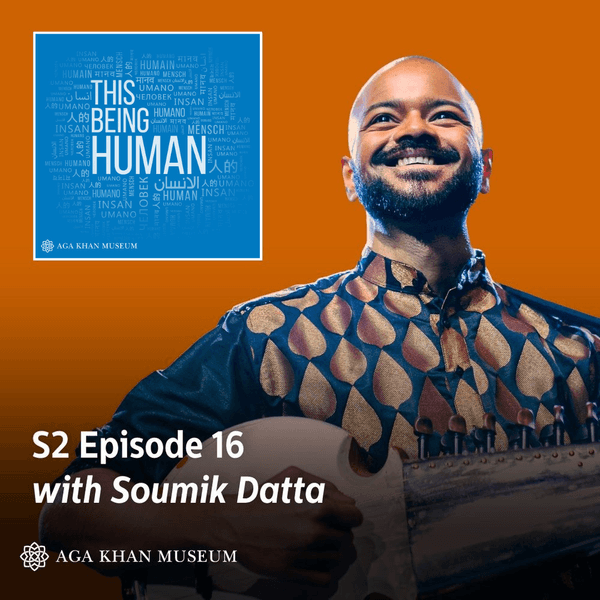
This Being Human - Soumik Datta
Soumik Datta is an award-winning musician, composer and television presenter. He plays the 19 stringed sarod and connects his Indian classical roots with colourful electronica and musical styles from around the world.
The Museum wishes to thank Nadir and Shabin Mohamed for their founding support of This Being Human.
Seasons 2-4 of This Being Human presented in partnership with TVO.
MUSIC
ABDUL-REHMAN MALIK(VO): Welcome to This Being Human. I’m your host, Abdul Rahman Malik, on this podcast from the Aga Khan Museum, I talk to extraordinary people from all over the world whose life, ideas and art are shaped by Muslim culture
NADIR NAHDI:
There’s a new generation that has a very unique perspective to how they see themselves as young Muslims in the modern world.
TANYA MUNEERA WILLIAMS:
I am this wide-eyed girl. I’m like, I want it all, I want to experience it all.
GINELLA MASSA:
Everyone has a story. Sometimes you just have to find out what it is.
ABDUL-REHMAN MALIK
Like the poem that inspires this podcast, the guest house by Sufi poet Jalal din Rumi. We’re talking to people who seek meaning and joy in work and life, regardless of what the day brings you.
ABDUL-REHMAN MALIK
Soumik Datta didn’t find his instrument. The instrument found him.
SOUMIK DATTA
I am a piece that falls in the journey of that sarod instead of the other way around. The story started before
I was born.
ABDUL-REHMAN MALIK: Soumik is a virtuoso sarod player trained by a guru in India. The sarod, if you’re not familiar, is a popular stringed instrument in South Asia, a member of the lute family that was invented about 200 years ago. But if you have any preconceptions about what a classical Indian musician sounds like, they almost certainly don’t apply to Soumik. Soumik lists Pink Floyd and Radiohead among his influences. He brings modern styles like RnB and drum and bass into his songs. He’s performed with Beyonce, Jay Z, Joss Stone Nitin Sawhney and Anushka Shankar, among many others. But there’s much more to show mix artistic career than just his talent with the sarod he also co founded a charity, Soumik that the arts that supports community arts projects and his own musical outings bring together a diverse range of collaborators to tackle big themes like climate change and the stories of refugees. Soumik is one of the winners of this year’s Aga Khan Music Awards, which recognize exceptional creativity, promise and enterprise in music and societies with a significant Muslim presence, the winners split a cash prize of 500,000 US dollars and are given professional opportunities like commissions and support for new projects. I called Soumik Dutta at his home in London. Our conversation touched on his relationship with classical music, turning down a tour with Beyonce, and the Fluke incident that brought him and his sarod together.
ABDUL-REHMAN MALIK
Soumik welcome to This Being Human.
SOUMIK DATTA
Thank you so much. AR, it’s great to be here.
ABDUL-REHMAN MALIK
You’re very welcome and much deserved. First of all, congratulations on this amazing award
and on this amazing citation.How does it feel to get a call and find out that you won a major music award.
SOUMIK DATTA
I mean, AR, I don’t know how to even start. I mean, it was literally a call, though, like it was a call from WhatsApp, call from one of the jury members, saying, can we have a quick chat? And I knew I’d been nominated, but this was before the pandemic, so it was not even on my radar at all, and it just came out of nowhere. And I’m so deeply honoured as sort of creative producers, especially those who sort of balance traditional heritage with sort of modern contemporary work and try to find bridges between them. That’s just what they do, and that’s just what I do. I mean, I love doing it. I don’t know what else I would do. I think I’d be very bad at everything else. And I just, I have a tremendous passion for it. I can find, you know, many, many hours beyond the 24 hour clock to do this work and just to get this award is just a huge, huge honour that I was not expecting at all.
ABDUL-REHMAN MALIK
I recently saw you and your incredible ensemble perform under the glass ceiling of a repurposed railway shed in Kings Cross, London. You had composed a new work to commemorate the 75th anniversary of partition and the founding of India and Pakistan. Tell me a little bit about being given this task to compose a piece of music that would capture this anniversary, but in many ways, also capture the stories, because I think you based your piece on reading stories of those who had experienced partition.
SOUMIK DATTA
Yeah, through my charity, over the last year, I’ve been working with refugees, refugee musicians, trying to see how displaced people who are now in the UK can be sort of re empowered through the arts. Can they be involved in the work that we do? Can they be involved in the productions, in the tour? And then, of course, the Afghanistan incident last year, where you know, just 1000s of people, and those you know, the news footage of people running off the planes and then seeing them, you know, sitting around in hangers at Heathrow and different hangers around the UK knowing that they were going to be re, you know, put up somewhere, and they need to restart their lives. So we did this project at the Southbank centre called Hope notes, where we interviewed refugees, and then I sort of composed music in response to their stories. And I think it was while that was happening that I was aware that, okay, now we’re into 2022, and there it is the 75th year of partition. And it occurred to me quite late that as South Asians, the experience of being a refugee is like runs quite deep in our DNA, and it’s something that would it’s not really talked about, because South Asians are just rubbish historians. I mean, as a as a people, which is awful, you know, we don’t talk about or write and discuss the things that happen to us in the way that other communities do. I just had to stop thinking of myself as a composer and as an artist reacting to a certain situation, I had to start thinking of myself as part of this global community of people who who had to question what home meant to them.
ABDUL-REHMAN MALIK
The sarod is such an emotive instrument, and it seems to be almost perfect for this question, and what does home mean to you? I mean, what was flowing through you, Soumik as you’re beginning to compose this music, as you’re improvising like you know, what’s emerging on the sarod for you, what are the notes that are calling you to answer this question, 75 years after these new homes were formed and old homes were lost.
SOUMIK DATTA If you are a student of Indian classical music, what you learn are raags. And a raag is set of notes played in a certain pattern to create musical phrases that are particular to that you know this, but for the listeners out there who might not know, you know so they create these unique phrases that belong to that raag. And as you’re learning, there’s always this sense of, Well, you can’t really question it. You can’t question the logic of why those notes were there, who made them, why do they belong to that raag, and why do they need to be played in that way? It just is. And that’s the nature of tradition, and that’s what sort of it’s beautiful as well. But when you start seeing it through a sort of socio political, historical lens, then you start thinking, oh, this raag sounds quite similar to this other one, which we know originated in Gujarat or something, but it has this other additional note. And then when you start, you know, looking at the sort of jigsaw puzzle of of raags and where they were created and where they came from, you start discovering things within them that are to do with people who made them and why? So this sense of, like, Indian classical music being a living organism is what I’m really interested in all my work. You know, I don’t want to think of them as sort of these archaic museum pieces that you have to play it in this way otherwise, you know, I’m interested in sort of figuring out why they’re played in that way, what was happening during that time. And, of course, when you start looking at all of that stuff, you get down to cast, get down to class issues. You look at how class and power played into the, you know, how where was this music performed? It was performed for the powerful by, you know, they were the patrons in courts and zamindars houses and so coming back to, you know, how I started thinking of this music, it was like, Okay, let’s look at some of this partition songs that we know. And then kind of think, well, what else could it have been given the other references around it. So yeah, it’s a sort of deconstructing of Indian classical music, while we are also deconstructing sort of what we think of ourselves as, sort of these South Asians in the wider diaspora today,
ABDUL-REHMAN MALIK
I guess, Soumik your brother is a photographer and a filmmaker. Your mom is a writer and a film director. I want to know what’s in the Datta blood.
SOUMIK DATTA
I’ll tell you what’s in the Dutta blood. It’s a lot of sugar and tea. And the home was basically, you know, people talk about melting pots. Well, the kitchen fire was always on the centre of my parents’ house. Wasn’t the living room, it was the kitchen. And that’s where I grew up, you know, before I went to boarding school, but that kind of idea of food is being made. It was a revolving door of artists and writers and creative people just coming through, friends with my mom’s, friends with my dad’s, so that kitchen would be alive with conversations about, you know, Urdu poetry, Satyajit Ray, ‘[. And I think, you know, I’m, I was just, I think about it now, I’m, I’m so blessed to have that as my reference of what home means. I have a very clear understanding of what home means and it’s very sad that, you know, there are so many people who don’t more and more now. I mean, if you look at what’s just happened in Pakistan, you know, with all the floods and the number of homes, that will never be the same. And I come back to the memories of that my parents made at my home, which centred around creativity and food, you know, which are those pillars of sort of South Asian, you know, households, I guess many South Asian households. I’m sure it was for you as well.
ABDUL-REHMAN MALIK 11:36
As you’re speaking, there’s so much resonance. It feels like you’re describing moments of my childhood as well, and it’s like the endless cups of chai, right? The endless cups of tea and the necessary fuel for conversations and reading and music. And I wonder what was the young Soumik listening to at home that got him really excited about music.
SOUMIK DATTA 11:58
So when I moved as a family, we moved from India, from Mumbai, and I was 10 years old, and I wasn’t really into music. I certainly wasn’t into Indian classical music. And I tell the story a lot, but my brother and I was sort of playing cricket in the living room, which was just filled with all these boxes because things hadn’t been unpacked yet, you know, the shipping boxes and and I hit the ball into a corner, and it sort of went twang. And I looked through the sort of the box and the moth eaten cloth, and inside it were these strings. And that was my grandmother’s sarod, which I had accidentally found that day, where I thought I’d broken it, but I just torn a string. And my dad came home that evening and he fixed the string, and he gave me my first lesson, and I just fell in love with the sound of it. And it was almost like my grandmother, who’d passed away by then, you know, had kind of left it for me, and it was waiting for me to find it. And so, yeah, I fell in love with the sound of the sarod and when I went to boarding school, you know, it came with me, and it became my companion for all those years. And so on one hand, I was listening to Amjad Ali Khan. I was listening to Ustad Ali Aqil, all these great ustads of the sarod tradition. I was listening to my own guru, Pandit Buddha, Devdas Gupta. I was learning from him every winter. I’d go and study with him for three weeks, almost live with him, really. But then I was also with young kids in London, and they were listening to a lot of Radiohead at the time. There was sort of experimental electronica happening, Talvin Singh and the whole sounds of the Asian underground that was quite big back then. And so there was, quite naturally for me, a bridge that started to get built between rag music, traditional Indian classical music and sort of contemporary sounds, bass, snare, voices, trumpet, orchestral sounds, samples. These things started to fuse over time and become sort of one thing. I don’t even know when or how, but certainly those seminal years as a teenager and going to sort of crazy gigs in East London and warehouse shows and probably illegal shows that would just sort of pop up and they’d just been, you know, put on there overnight. They were very formative experiences, yeah,
ABDUL-REHMAN MALIK 14:36
Really, it feels like you didn’t choose the sarod, the sarod kind of chose you.
SOUMIK DATTA 14:43
100% you know, I’ve thought about this before, because that particular sarod, you know, if my grandmother would have played it sort of in her youth. I mean, it’s, it was significantly older than me. So then I am a P. Space that falls in the journey of that sarod instead of the other way around, you know. So it does feel like the story started before I was born, you know. And when we talk about intergenerational things, you know, these days, we’re talking a lot about intergenerational trauma, which is good, but also about, you know, things that unite generations as well, and that particular sarod is, yeah, the story of it is, is inspiring, yeah.
ABDUL-REHMAN MALIK 15:27
What makes the sarod unique? It’s a popular instrument in Indian classical music, but I think a lot of people outside the subcontinent might not be familiar with it, and particularly, there’s something very beautiful and compelling about the way that you play it. It’s almost like an extension of you as you’re playing it. You kind of want to know what is this instrument and what makes it unique for you as a musician, in terms of your connection to it.
SOUMIK DATTA 15:52
What makes this the road special, I would say, is two things, composition and also the journey of the instrument itself. The composition is interesting because it’s made out of all kinds of different things. It’s made out of wood, it’s made out of stainless steel, and it’s made out of sheepskin, phosphor bronze. It’s like an assembly was needed, you know, committee was needed to, like, create this thing, a board of trustees or something you know, to like, make this thing. And of course, it’s fretless, which means you slide along this blank, empty fretboard with no indication of where the note is. And there’s something very special about that, of course, you know, and the sitar, for example, doesn’t do that. It has threats, it has denominations in the same way that a guitar does. And then historically speaking, it is it, you know, the sarod originates from another instrument, which is the Rabab, which is still played widely in Afghanistan. So, you know, at some point, you know, there are texts suggesting that the Rabab was also used by soldiers that carry it to war, that play it into battle, sometimes on horseback. Not sure how the physics of that works, but they, you know, there are suggestions that that happened. And then the story is that three sarod playing Persian warriors came south of the Indus Valley and settled in different parts of India, and then tried to, sort of, yeah, play Indian music and just become part of Indian culture. And of course, they couldn’t, because the Rabab had catgut strings, which is much thicker, and you can’t do the gliding kind of sounds that Indian music holds right at the centre of its sort of sound idiom, you know, the mean or the glide. You can’t do that with the thick cat gut strings on the Rabab. So, so they started adapting the instrument. So there’s a story of migration, there’s a story of travel, and then there’s a story of like, adapting into a new culture. And I just find it really inspiring that this one instrument, the evolution of the instrument, has this journey, like wired into the DNA of it.
ABDUL-REHMAN MALIK 18:11
I love this idea about this kind of notion that comes with so much of Indian classical music around the notion of the teacher and the student, you know, the master and the disciple. And I think, in our sort of, for lack of a better word, European, Western context, right, we feel a bit and rightfully so at times, right, critical of the idea of the master student relationship. There’s power dynamics there. There’s things that make us feel uncomfortable. But when you look at instruments like the sarod, learning from a master teacher is vital, isn’t it, to keep the link with that instrument of the generations who played it before and who understood it. What was the time like for you with your master teacher? Because there were times when you lived in the same home, didn’t you with your master teacher? Must have been an intense experience, Soumik.
SOUMIK DATTA 19:14
My relationship with my guru was very special, and will always be till the end of my life, he’s passed away now, but, you know, I now have a collection of memories from the day we met. The first time I met him. It’s towering giant of a man, and I was a kid, and he said, play, show me what you know, you know. And then later on, I remember being on tour with him and helping him with, you know, carry things and his own instrument. And I remember I broke a Tanpura once that I was meant to look after, and how he consoled me when that happened. And sometimes we’d be at the back, I’d be at the back of the car, and he’d, we’d be driving through the marketplace in Calcutta. And on one hand, he’d be sort of negotiating the price of fish through the driver’s seat window while teaching me some rhythms. You know, it’s incredible, yeah. And he had many, many students, and many generations of students, and it just spoke to his, his incredible ability to give, to inspire, to share knowledge. And I don’t know that many other great ustads like that.
ABDUL-REHMAN MALIK 20:34
Soumik’s albums vary in style. All of them are surprising and unique in their own ways, each has distinct themes, musical elements and a wide range of collaborators. Some are more R and B influence. Others orchestral his ambition, passion and eclectic tastes immediately come through in all of them. But early in his life, before any of those albums came out, of course, Soumik hit a pretty high note in his career. He got the opportunity to perform live with Beyonce. I’m pretty sure he’s the first guest we’ve had on this being human, who can make that claim.
SOUMIK DATTA 21:17
It was actually a Jay-Z tour. So he was on this world tour, and he had a London date at the Royal Albert Hall. I was playing a lot with Tarvin Singh. I was still kind of just finishing off University, actually, so, oh, maybe that was the year I was just doing my finals, or my exams or something. I can’t remember. I was graduating, and he and I got sort of invited by the arranger of the London Jay-Z concert to be part of that show. So I had no idea that Beyonce was going to be involved. You know, I was interested in in rap. I was a big Eminem fan for many, many years. And so, yeah, doing this concept was, I said, of course. And we started rehearsing. And then as we came close to the show, there was one rehearsal where people sort of stopped for a second, and there was this sort of kind of weird pause in the room, and everyone just looked around. You know, is that it’s that scene at the end of is it Infinity War Avengers, where Thanos arrives in the forest and everyone’s like, wait, what’s happening? Something weird is happening. There’s like a rustling in the leaves, right? You know, but you can’t see it. You can just sort of feel a tension or something. It’s like a tremor in the forest. Yeah, yeah, exactly, exactly. That’s what it was like. And the doors opened, and she came in, and she’d just been shopping, so like her entourage holding up bags and stuff, and she came in and she was glowing, and that was the first time I saw Beyonce, and she sat and heard the rehearsals and and she said, Jay, I’m gonna do a track, and I want these guys on it. And she pointed at me. And in my memory, I think she smiled and kept staring at me for a bit longer than anybody else, I think. And no, it’s not true. And then, yeah, we performed a few tracks at the Royal Albert Hall show with strings and with Jay-Z rapping, and with sarod and tabla,
ABDUL-REHMAN MALIK 23:25
that’s so cool. Did you actually turn down an opportunity to go on tour with them?
SOUMIK DATTA 23:30
After that, there was a sort of talk about because the tour kept the tour was quite long, and there was talk about sort of more shows, and this is what I can’t exactly remember, but I think it was because I was still finishing off University, and like, you know, like a good Indian kid, I thought that it might be worth finishing my education rather than going on tour with pop and rap and R and B royalty.
ABDUL-REHMAN MALIK 23:58
You in Urdu, we’d say you’re such an acha bacha.
SOUMIK DATTA
Acha bacha, yes, in some ways, I think I might have been an acha bacha in other ways, maybe not so, but yeah,
ABDUL-REHMAN MALIK 24:16
Soumik Datta, who or What would you like to welcome into your guest house.
SOUMIK DATTA 24:23
Honestly, AR, I think I want to just keep the doors of the guest house open for anyone and anything, and get away from this sense of sort of needing to fix things, because that doesn’t put us in the present. It puts us in this present continuous whereas being in the present means just dealing with everything right there, because we’re alive, we feel different things. Our relationships are constantly in flux. Things in the world are constantly in flux, and there’s no way anyone can just lock those things away and just fix things. So this sort of capitalist idea of like buying stuff to fix things is I just want to get away from it. And yeah, I think that poem is so beautiful. And it just says, be alive to the things around you and to the feelings inside you and the people around you.
ABDUL-REHMAN MALIK 25:26
Soumik Datta. What an honour and privilege it’s been to have you on This Being Human.
SOUMIK DATTA 25:31
Thank you so much. AR, thanks for having me.
ABDUL-REHMAN MALIK 25:55
Thank you for listening to This Being Human. We’ve included some links in the show notes where you can read more about the Aga Khan Music Awards and learn about the other winners who are all worthy of your time and attention. We’ll also include some links to some of Soumik Datta’s projects and videos. This Being Human is produced by Antica Productions in partnership with TVO. Our senior producer is Kevin Sexton. Our associate producer is Hayley Choi. Our executive producer is Lisa Gabriel, mixing and Sound Design by Phil Wilson, Original music by Boombox sound. Stuart Cox is the president of Antica productions Shaghayegh Tajvidi is TVO’s, managing editor of digital video and podcasts. Laurie Few is the executive for digital at TVO. This Being Human is generously supported by the Aga Khan Museum, one of the world’s leading institutions that explores the artistic, intellectual and scientific heritage of Muslim civilizations around the world. For more information about the museum, go to www.agakhanmuseum.org the museum wishes to thank Nader and Shabin Mohamed for their philanthropic support to develop and produce This Being Human.