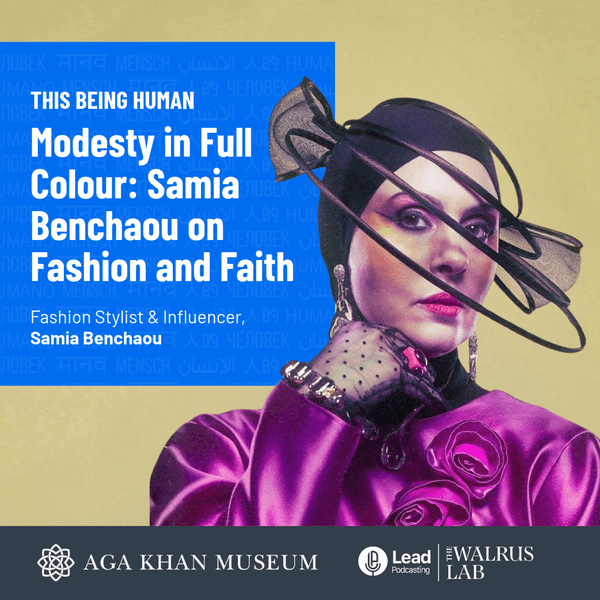
This Being Human - Samia Benchaou
Samia Benchaou is a Copenhagen-based Moroccan-Danish stylist and content creator known for her bold, colourful approach to modest fashion and hijab styling. After joining social media in 2019, she built an international audience around inventive styling, confidence and self-expression. Her work has been featured by outlets including People and Vogue Scandinavia.
The Museum wishes to thank Nadir and Shabin Mohamed for their founding support of This Being Human.
Show Notes
For Samia Benchaou, modesty has never meant blending in. The Moroccan-Danish stylist has built a global audience with bold colour, unexpected layers, and an approach to hijab styling that treats fashion as a space for creativity and self-expression.
Host Mai Habib talks with Samia about finding fashion later in life, drawing inspiration from both her Moroccan and Danish roots, and refusing to shrink herself to fit expectations of what a Muslim woman should look like. They also explore the fashion industry’s blind spots, the assumptions attached to the hijab, and why Samia has stopped trying to prove she belongs in spaces that weren’t built with her in mind.
Links & Resources
- This was just one example of Muslim art that sparked curiosity and a great conversation. There is so much more to see at the Aga Khan Museum. Support the Museum’s vision to impact lives and contribute to more inclusive and peaceful societies. Go to agakhanmuseum.org to plan your visit or make a donation.
- Follow Samia Benchaou on Instagram for more of her colourful looks, creative layering and modest-fashion transformations.
- Read more about Samia in her profile on People Magazine.
- Check out more episodes in full video.
Visit the Aga Khan Museum’s website or follow us on Facebook and Instagram.
If you enjoyed this episode and want to learn more, go to agakhanmuseum.org/thisbeinghuman.
Mai Habib [00:00:21] Welcome to This Being Human, an Aga Khan Museum podcast about Muslim art, global cultures, and how we’re all connected. I’m your host, May Habib. Fashion is about so much more than clothes. It’s language, identity, memory. It’s a way of telling the world who you are without even saying a word. Across cultures and generations, what we wear can carry history, it expresses our as belonging and it becomes a canvas for creativity. For Samia Benchaou, that language is bold, it’s colorful, it’s deeply personal, and it is certainly modest. A Danish Moroccan stylist and fashion influencer expressing her identity as a Muslim hijabi woman, Samia has built a global audience by turning everyday style into something expressive, playful, and powerful. Through her unique looks and growing online presence, Samia’s challenging assumptions about modest fashion and opening up new conversations about confidence, visibility and representation. Welcome, Samia. Thanks for joining us today.
Samia Benchaou [00:01:22] Thank you so much for having me.
Mai Habib [00:01:24] First of all, like take us back to when you realized that fashion was your calling. And when you sort of put it together that, you know, I’m pretty good at this and this is my happy place.
Samia Benchaou [00:01:40] In 2018 I was like, I was a stay at home mom actually for many years. Um, and then I was, like, what am I supposed to do with my life? And then one of my old friends said, how about you going into fashion? I was. That’s a good idea. So I took a degree in styling, uh, which was a waste of money. If, if you ask me, because either you, you, you got the skill or you don’t.
Mai Habib [00:02:05] Mm-hmm in my yeah, you can’t be taught right, right
Samia Benchaou [00:02:08] Yeah, so yeah, I did that. And that was actually the beginning of it all. And then I got social media in 2019. I have never had it before. So that’s how it began. And it exploded when I started making the reels every day. Like, consistent. That’s how I got so big or whatever on Instagram.
Mai Habib [00:02:36] That’s so interesting. Okay, so now you’re here. Did any of your family or friends react in any way, you know, when your social media sort of blew up?
Samia Benchaou [00:02:47] Yeah, actually, like, uh, so I’m divorced now after 20 years. So happy about that decision. Uh, my husband, my ex-husband was not happy about it. Um, I don’t have, uh. Um, how do you say it? A relationship with my siblings anymore. Actually after I, I’m very like open-minded and very honest as a person. That’s just who I am. Uh, yeah, they, they just think it’s embarrassing. So I actually don’t have, um, a relationship with them anymore.
Mai Habib [00:03:20] Oh, wow. Because of this?
Samia Benchaou [00:03:22] Yeah. Like they, because like, eh, it’s embarrassing that a woman, uh, of a certain age is acting like that on social media. I mean, everyone is entitled to their opinion, but like my point of view on life, like you shouldn’t judge others.
Mai Habib [00:03:43] Do you think it’s rooted in a more sort of Muslim conservative point of view?
Samia Benchaou [00:03:49] There are things you have to do as Muslims. Of course, at the end of the day, we all have a choice. I mean, our creator gave us free will to do whatever we want, you know. But I mean you know, you have to pray, you have to fast, you have to believe in God and so on. And then it’s like you have different opinions. Can you wear pants? Can you hear music? How to pray with your arms is like this and like that.
Mai Habib [00:04:20] Right.
Samia Benchaou [00:04:20] And that’s how it is. But I mean, some go to the extreme and just want to put their own idea of their own…
Mai Habib [00:04:32] Right, like their own points of views or like it’s a cultural influence more than it is their religion. Yeah.
Samia Benchaou [00:04:39] That’s when it becomes a problem, you know, just respect others’ opinion. We don’t have to go to war or hate each other because of that.
Mai Habib [00:04:48] That’s a very common theme that we’ve had on the podcast actually is that Islam, otfen is sort of, people understand it as this big monolithic thing, right? Like that the whole Muslim population is homogeneous. We all feel the same We all think the same but actually there’s a lot of intersectionalities of culture of points of view There are a lot, you know of Muslim diasporas in sort of Western countries that have been influenced there as well and see things So I respect what you’re saying very much And I want to bring it back to the fashion because that’s that is your place That’s where you thrive and you could tell that it really makes you happy. I’ve been watching a lot of your social media So Tell me about like your fashion process. You’re you’re colorful. You are loud It’s bold. How would you describe your fashion in your own words being true to myself?
Samia Benchaou [00:05:39] I mean, it’s self-expression. It’s powerful. It’s a way to show what I’m passionate about and my personality. Like I am the type, like I don’t give a beep. I’m honest. I’m bold. I’m fun. I’m loud. I say my opinion. So that’s also what you can see through my fashion choices.
Mai Habib [00:06:09] It’s interesting because I don’t think that it’s only Muslim women that are told not to take up too much space. I think that that is a common theme kind of no matter where you are. Right. But you’re not afraid to take up space in a room.
Samia Benchaou [00:06:25] No, not at all. Like, I… I really don’t care, like I’m just being myself. Then you like it or you don’t like it. Like it’s, I really, I don’t really care. Like, as long as I know I’m a good human being, then you can have all the opinions you want about me.
Mai Habib [00:06:40] And I mean, part of being yourself is that you are clearly a veiled woman, right? Like for listeners, Samia wears the hijab, which is the head covering of Muslim women. How challenging do you find it to express yourself through fashion, through this passion of yours, while also being a hijabi woman?
Samia Benchaou [00:06:59] I mean, it is a challenge sometimes, but I love it, you know, because then I can get creative, uh, how to wear things and so on, what to put underneath. And, and of course there are certain limits because you can’t like style everything, but nearly everything I can style, uh to make it more modest. Uh, so yeah, it’s fun. It’s yeah, It’s, it’ my happy place. It’s as I said, where I can get creative and, and, so on.
Mai Habib [00:07:28] So yeah And whenever you do make it more modest, like whenever you’re telling the folks this is like the hijabi approved version, I love that you always say, keep it halal. This is to keep it Halal. It’s a thing now, seriously. It’s thing, and you know, it’s funny because I’ll look at the comments and what is clearly non-Muslim or like Western-based women are even saying keep it, halal and so. I love it. Yeah. How are you finding the reaction generally to the sort of this more modest fashion space?
Samia Benchaou [00:08:01] Honestly, like I really feel honoured because there are so many non-Muslim women who are following from all over the world and and and it’s it’s just I mean it makes me so happy because here in Denmark it’s like it’s a very small country we are only nearly like six million people and here it’s their mentality is like if you don’t take the Danish values, you can just go home, as they say. Then you’re not a part of the society or whatever. But I can see like other women or people from around the world, they are like respecting that I’m staying true to my belief and my culture. And that just, it’s just such a beautiful thing because I’m not used to that here in Denmark. So I’m really happy about that because I mean, We all just have to respect each other, also because you can learn so much from each culture and each nation, religion, whatever, you know, there are so many beautiful things to discover from each country and nation.
Mai Habib [00:09:11] You mentioned living in Denmark, so, you know, you’re Danish because you live there, but you’re also Moroccan sort of by ethnicity, and you’re Muslim. How do these three parts of your identity influence your fashion and your fashion choices?
Samia Benchaou [00:09:29] I definitely think that because, I mean, here in Denmark, they are very conservative dressed, like the way they dress, it’s a lot of black and beige. All right. More muted, more subtle. Um, so, so I, I definitely think that that’s my Moroccan side. And because in Morocco, we, we love a lot of colors and, and, and also the, the, The, the culture, the artistic, uh, I mean, the jewelry, um, and so on is, it’s just very different from, from the Danish minimalistic. I mean that’s also beautiful. We have a lot good designers here and furniture designers and so on. So it’s a good mixture, I would say. I mean, I’m influenced by both worlds, I will say, yeah.
Mai Habib [00:10:20] So you talked a lot about sort of the positive reactions that you get from people. Tell me a little bit about any kind of negative spaces you may feel being a Muslim fashion designer, being in this space as a Muslim woman.
Samia Benchaou [00:10:36] So unfortunately, I would say, uh, luckily for me, I feel blessed. Hamdoulillah, like I, I mostly get a lot of love, like maybe once a month, twice a month, and I get a hate comment. I mean, sometimes it’s really.
Mai Habib [00:10:53] Are you are you saying like it’s it’s hateful, like it is very hateful?
Samia Benchaou [00:10:56] Oh yeah, like it’s like sometimes they say like take off your hijab, you’re working with the Jews.
Mai Habib [00:11:05] Very condescending, right. Right, right, right. Very, very derogatory. Okay.
Samia Benchaou [00:11:09] And I just have to say to myself, listen, it’s just people who are not happy with themselves because I simply do not believe that if you’re a good human being and you are thriving and living your life, you don’t have the need to, to, to spread hate, hate comments, at least not my opinion. So that’s what I say to comfort myself. That human being is not happy about themselves. Just, just leave them and, and, and go on with your life. You know, for example, my most viral video, I have this like silver top there. People were commenting a lot like hateful comments. I can’t say Western top. I can say, okay.
Mai Habib [00:11:51] Less modest clothing, like when you’re taking less modest clothing and you’re trying to make it right. Right, right.
Samia Benchaou [00:11:56] Then people can comment on that, but otherwise it’s just all love, honestly.
Mai Habib [00:12:03] And that’s amazing because I don’t think a lot of social media influencers can actually say that. And I think Muslim women are not. A lot of Social Media influencers get the same sort of reactions you get. So I don t even know if being a Muslim woman is necessarily the common denominator there.
Samia Benchaou [00:12:20] One of my followers, I clearly remember what she said because like I made a video of thanking my community and so on. And she said, you get what you put out there yourself. So that’s why you are getting so much love and so much good energy is because that’s what you yourself are putting out there. I was like, And it feels good.
Mai Habib [00:12:43] Yeah, yeah, I really got to know you through the people magazine, right? Like you’ve been featured now and Vogue and people is where how I kind of came across you and then I started following and kind of watching everything you’re doing and I got to tell you that some, some of the comments, there was a lot of love, but some of comments on that people post, they did not pass the check. One comment that really stuck with me that said, stop normalizing Islam.
Samia Benchaou [00:13:14] Yeah, well.
Mai Habib [00:13:15] And that just blew my mind because this is a religion of two billion people around like it is normalized like it’s it’s this is not some sort of fringe minority offshoot cult that’s this is very I think it just really made me realize because I too am in you know safe spaces much like you and I’m hearing a lot of positive sort of feedback but there’s still a lot of misunderstanding about what Islam is, what it means to wear the hijab. Often people think that women wearing the hijaab are oppressed, like you are forced, you’re oppressed, you’re locked up. How do comments like that sit with you?
Samia Benchaou [00:14:00] As I said, I live in Denmark and the politicians are very, they say it out loud, what they think about the Muslim community. So unfortunately we are used to it, but I would also say like the West did well on that propaganda, their agenda to have a certain view on the Muslim, on the Muslims in general.
Mai Habib [00:14:25] Mm-hmm.
Samia Benchaou [00:14:26] So that’s why some of the world see you as they see you as Muslims. Like they, like Islam is equal to you’re oppressed, you’re a terrorist, you’re just bad. Right. I mean, I’m laughing, but it’s not funny, but it just insane. And I would say you are immature intellectual when you can have that… Point of view, as you say, on 2 billion people. Like in my view of life, like in every single country, you will find good people and bad people. No matter every religion, every culture, if they don’t believe, I mean, that’s just how the world is.
Mai Habib [00:15:17] Absolutely.
Samia Benchaou [00:15:17] People should travel more, I think.
Mai Habib [00:15:20] Yes. Open your minds up. And specifically as a hijabi woman, how do you explain or what do you want people who believe that you wearing the hijab or other women wearing the Hijab is a sign of oppression? What do you wanna tell them or explain to them about wearing the Hijab?
Samia Benchaou [00:15:38] People are also coming back to me and saying, Samia you are building bridges and saying like like like you are showing the world how Muslims can also be but I’m like that was not my intention and that’s just a side bonus because I’m just here for the fashion I’m just here to inspire with the fashion it was not my goal to build bridges. I don’t have to prove I’m not oppressed.
Mai Habib [00:16:06] I think it’s important for people to understand that a lot the majority of Muslim women are choosing to wear the hijab because it is part of their religion and ask from God to be more modest.
Samia Benchaou [00:16:17] Yeah, exactly.
Mai Habib [00:16:19] And I’m a Muslim woman and I choose not to wear it, right? I think that that’s really also important to acknowledge.
Samia Benchaou [00:16:24] Yeah.
Mai Habib [00:16:25] So, you know, in your posts, you talk about diversity and sort of a lack of diversity in the fashion space, right? Particularly a lack of Muslim voices. Tell me about that. Tell me how we can change that.
Samia Benchaou [00:16:41] I just recently made a video that that because I have really knocked on so many doors to get into Fashion Week, you know, in Riyadh, in even in Morocco, in Denmark, New York, whatever Paris, because I can see people with way less followers. Because I was always told it’s about followers. It’s about the interactions. It is about the Comments and I was like, okay. I’m good. I have a lot of interactions, you know, it’s gonna be easy No, it’ not as we talked about before that people have a certain Um A certain mindset view of the muslim woman. Um Yeah, so so so I I took a choice to not knock on these doors anymore because if you don’t want me in that space, it is what it is. Like I have built my own, I’m self-made. So I’m gonna continue building my own. I don’t need to be in spaces where I’m unwanted. I have used too much energy on that. So I… I’m done with that, to be honest, also chasing brand deals and so on when they only want women who doesn’t wear the hijab.
Mai Habib [00:18:15] And zooming out a little bit too. I know your experience is deeply personal, but zooming out and looking at the landscape in general. I mean, hijab wearing women are not a small population. It’s a large population. Yeah, and it’s a large population. Yeah, it’s it’s a large population to cater to. You know, we spoke to a hijabi athlete on the podcast, actually, and we were talking about how Nike came out with like more conservative and hijab sort of approved and Muslim approved athletic wear right to kind of meet that moment. And there is a lot to be said about this population. As a, I mean, if you’re looking at it, just economics, strictly economic as a customer base, but then sort of catering to this larger, more diverse population, can you see that space being forged, knowing what you know about the fashion? Is there a space for more modest dressed women? Is there space for hijabi woman fashion in the global fashion scene?
Samia Benchaou [00:19:25] Definitely. Like, they are missing a huge market. Like we like to spend money like everyone else on fashion, on beauty, on whatever it is, like food, cars, whatever. I mean, so looking at it from like an economic aspect, I really don’t get it. I don’t get why they would miss on such a huge market. I mean, Dolce& Gabbana has gotten the point. Not that I want to sit here and promote them, but like they literally make a collection dedicated to the modest women. But they are one out of, I don’t know, a million who got the memo.
Mai Habib [00:20:11] And maybe more, right? I think maybe that’s part of what this conversation is too, is to kind of say, Muslim women are here and we take up space and some of us wear hijabs and we want to look good, be confident, feel good, even if our choice is to be more modest. Yeah, exactly, for sure. And for women who wear the hijab and do wanna style. Talk us through like a demo style right now. And you know, we have listeners and we have viewers. So for the people who are listening to make sure you’re very descriptive. Talk us through a styling for a hijabi woman. What should she be aware of? What should she think of?
Samia Benchaou [00:20:52] Okay. So I would say, like, and that’s for all women whether hijabi or not like have good basics because as I’m also showing in my video like I have used a pair of jeans and for example a white shirt so many times. You can just style it in so many different ways.
Mai Habib [00:21:13] You know, we talked about wearing the hijab before and, and you know, I like your idea of I don’t need to justify this, you know to anyone else. Why is it so important that you keep showing up with your hijab and being loud on social media?
Samia Benchaou [00:21:29] It’s a part of my identity as a Muslim woman. That’s as simple as that. Like I show I’m a Muslim woman when I wear the hijab, then you know I’m a Muslim woman.
Samia Benchaou [00:21:41] Does your daughter wear the hijab too?
Samia Benchaou [00:21:42] Alhamdulillah, she does.
Mai Habib [00:21:43] Alhamdullillah. Okay, by choice.
Samia Benchaou [00:21:45] By choice. She started when she was like six or seven. I said to her, Hanifa, you don’t have to wear it, but she wants to wear of course because I’m wearing it.
Mai Habib [00:21:55] You talked about your daughter and she’s watching you and positively influenced by you wearing a hijab and you can still accomplish everything you want to in life even if you’re wearing the hijab. What do you say to the younger generation of Muslim women out there?
Samia Benchaou [00:22:10] Be proud of who you are. And again, I would say, you don’t have to defend yourself. You know you have beautiful values. At the end of the day, it’s God that is gonna judge us. So why would you care about human being judging you who are not even happy about themselves?
Mai Habib [00:22:32] Thank you so much, Samia, for joining us on this. Being human has been such a great conversation and people can follow you on Instagram and see all your styling videos. And yeah, just be inspired and be prepared. It’s gonna be loud with lots of bold colors and it’s just, it’s a great, yeah, it is a great Instagram to follow and lots of great content out there.
Samia Benchaou [00:22:52] Thank you so much for having me.
Mai Habib [00:22:54] This Being Human is brought to you by the Aga Khan Museum, a place where centuries of art inspire new conversations every day. This podcast is produced by Jules Owenby and edited by Zia Khaled. Amanda Cupido is our executive producer. I’m your host, Mai Habib. If you enjoyed this episode of This Being human, be sure to hit that follow button to catch the next episode available on YouTube and wherever you get your podcasts.