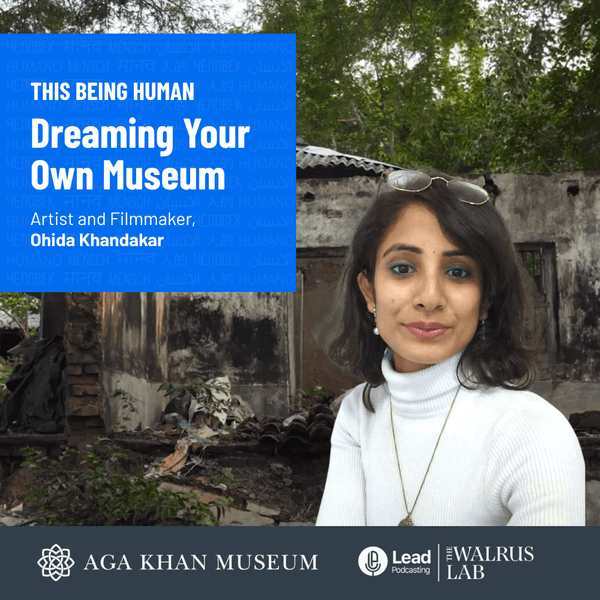
This Being Human - Ohida Khandakar
Ohida Khandakar is a visual artist and filmmaker based in the Netherlands. Her practice explores themes of memory, rural marginalized voices, non-linear narratives, and gender inequality through various mediums including lens-based media, drawing, painting, and installation art.
She obtained a BFA in Painting from the Government College of Art & Craft in Kolkata, along with an MFA in Painting from Jamia Millia Islamia in New Delhi. Her work has been internationally exhibited and received several awards. Most notably, she is the 7th recipient of the Jameel Prize (2024) for her film Dream Your Museum, which was also showcased at the 12th Berlin Biennale for Contemporary Art (2022), the 59th International Art Exhibition, La Biennale di Venezia (2022), and the Emami Art Experimental Film Festival in Kolkata (2022).
The Museum wishes to thank Nadir and Shabin Mohamed for their founding support of This Being Human.
Show Notes
Some museums you visit. Others, you dream.
In this episode of This Being Human, host Mai Habib sits down with artist and filmmaker Ohida Khandakar to discuss her award-winning film Dream Your Museum. Ohida reflects on how her Uncle Selim Khandakar’s collection of over 12,000 ordinary—yet utterly extraordinary—objects, acquired over 50 years, became a living museum through imagination and storytelling.
From a mud house to the Victoria and Albert Museum, Dream Your Museum rethinks exhibition spaces, emphasizing dynamic engagement with culture and everyday life as their defining attributes.
Follow along as Ohida shares her experience navigating the arts as a Muslim Indian woman, the process of curating and documenting a museum that comes to life, and why you should dream about the impossible. She also offers up the essentials to dream your own museum: inspiration, creation, and human connection.
Links & Resources
- This was just one example of Muslim art that sparked curiosity and a great conversation. There is so much more to see at the Aga Khan Museum. Support the Museum’s vision to impact lives and contribute to more inclusive and peaceful societies. Go to agakhanmuseum.org to plan your visit or make a donation.
- Visit Ohida Khandakar’s portfolio to see her gallery and more of her artistic background.
- For more information on Dream Your Museum’s 2025 exhibition at the V&A, check out Jameel Prize: Moving Images.
- Read more about Jameel Prize winner Khandakar Ohida: ‘Personal stories open universal memories’.
- Check out more episodes in full video.
Visit the Aga Khan Museum’s website or follow us on Facebook and Instagram.
If you enjoyed this episode and want to learn more, go to agakhanmuseum.org/thisbeinghuman
Mai Habib 0:10
Welcome to This Being Human, an Aga Khan Museum podcast about Muslim art, global cultures and how we’re all connected. I’m your host, Mai Habib. Traditional museums come with a lot of unspoken rules. You can look, but don’t touch. Keep your distance. The art is precious and untouchable, and there’s very little room for play or interaction. But what if museums didn’t work that way? What if they didn’t just show art, but they let us live it? Today we’re diving into Dream Your Museum, by Ohida Khandakar, a film that doesn’t just rethink what a museum can be, but completely reimagines it. For those of you listening, and curious about all the visuals that we’re mentioning throughout the episode, don’t forget you can watch the full video version on YouTube to see everything that we’re discussing. Hello, Ohida, welcome to This Being Human.
Ohida Khandakar 1:00
Hi. Hello, nice to meet you, and thank you so much for inviting me.
Mai Habib 1:07
Absolutely. We’re very excited to have you here. Can you tell us a little bit about your background? What sparked your love of the arts and filmmaking?
Ohida Khandakar 1:18
So, I studied from the Government College of Art and Craft in Kolkata. I completed my grad school from that art school in 2016 in painting. And then I did my masters from Jamia Millia Islamia in New Delhi in 2018, again, in painting. And after that, I kind of moved towards more filmmaking. So right now, my practice is mostly based on film, painting, drawing, installation, video art, all in these mediums.
Mai Habib 1:48
Is there something that inspired you in your youth to go into this sort of more creative path?
Ohida Khandakar 1:54
I would say, when I was class seven, class six. So it was always like, because I was born and brought up, you know, a traditional Indian Muslim family, it was like, I was ashamed to say that I want to study painting or I want to go to art college. So I never got the courage to tell. But somehow my grandfather, I would say, and a little bit of my uncle, Khandakar Selim, actually, who was making these museums and all these ideas, I told both of them, especially my grandfather, I said first, and he agreed. He’s like, “Oh yeah, I have seen. You have painted so many small, small drawings and pasted them on your house wall. And, I mean, on your room wall. And, yeah, you should study art, something like this.” So he supported me, and that gave me a lot of courage. At that time it was like I just completed my 10th and then gradually, because the art college was in Kolkata, which is almost three hours far from the village, and in this village, there is no artistic culture, because it’s a small, tiny village. So, yeah, obviously you won’t know. So I didn’t know that art college, something, exists. So then my uncle at that time used to stay in Kolkata, and I asked him, like, do you know if there is an art college? He was like, “Yeah, there’s a lane called Park Street, like Jawaharlal Nehru, some sort of lane. And there is this Government College of Art and Craft.” And he’s like, “You should go, actually, you should go there and check it out. You know about the admission process and all.” So, yeah, eventually I went there. And then my family began like, “Oh, no, you can’t. You’re a woman. You’re a Muslim woman. Why will you study art?” I was like, “Why not?” And then I think somehow my father was not happy with my study in the beginning, because he used to think, like, oh, you know, a rural Muslim woman. He was like, “Oh, just do a normal study, complete your graduation and get married.” But for me, like I want to study art, I don’t know otherwise I won’t be able to study any other subjects. So I think that kind of gave me more courage, because in the initial stage, I was not getting that much support. And especially, I would say, even if you go to art school, you need to buy stuff for like drawing, painting. But luckily, I got some students whom I used to teach, and I used to get a little money, and that helped me to do more art. And then eventually… First year, I didn’t get a chance in art college in 2011. After my 12th grade, then I took a gap year, and that was like my dad was more angry because I was taking a gap. They’re like…
Mai Habib 4:33
You’ve got to go get it.
Ohida Khandakar 4:33
Yeah.
Mai Habib 4:34
Education, education, education,
Ohida Khandakar 4:36
You are wasting one year. And I was like, “I’m not wasting. I will do good. You just, you have to just believe me.” But he didn’t believe. I would say, obviously he didn’t believe a long time. I mean, recently… I mean after COVID, when I started to work more, then they understood a little bit. Otherwise, yeah, it was always a difficult situation. But yeah, I think then second year I got a chance, and when I got to the Government Art College, then I thought like, oh, now I got the platform. Now it’s my duty to work and start. And then, yeah, gradually I learned. I learned, and then did my masters. And then, yeah, now I’m here, and I think I’m still learning.
Mai Habib 5:18
You know, you mentioned your uncle, Selim, as one of the people who was really supportive of you going into sort of your dream pathway. And now your film Dream Your Museum is centered around him. His, you know, 12,000 plus objects that he’s collected over 50 years, and I even read that some of them were gifted to him by patients because he was a doctor’s assistant. I mean, tell me about this full circle moment. What made you come back and want to showcase him? Where did this idea come from? And even more, why is it called Dream Your Museum?
Ohida Khandakar 5:59
What happened was like, when I left home and I went to art college for my grad school, and then after the grad school, I wanted to go to Delhi, because within West Bengal, I was like, no, I need to know India, like West Bengal, is one state only. So then I thought, I will go to Delhi. And I went for my Masters. And actually before art college, when I took a one year gap in 2011-12, at that time, my uncle used to give me a lot of museum catalogues, a lot of exhibition catalogues that he used to collect from Kolkata because he was a doctor’s assistant, a compounder who was working in Kolkata. So he used to go to a lot of stamp exhibitions, or any small exhibitions, like Birla Academy. There are many other art institutions or art spaces, so he used to visit all those. So then I got some more encouragement from him. And then when I did my masters from New Delhi, I was kind of studying, I was happy, like, oh, now obviously I’ll do something in the arts. Yeah, either some more producing work… And I was doing that, and then COVID. I completed my Masters in 2018, just in 2019 I was practicing, and then in 2020, from the beginning, COVID came. And then it was really difficult, you know, to survive in Delhi, because it was so expensive and all. Then I had to return to my village, not even in Kolkata, like even in my own village… Like this, this room actually, I still remember. And then I think I was also a little traumatized by all this COVID, I was like, oh, my God, I somehow managed to get my little career. And COVID is destroying everything. What will happen? No, it should not happen. And it was so paranoid for me. I was already so unhappy with my life at that time. For six, seven months, it was really… I think most of the artists in this art world and film world were really bad at that time. So I think when I came, that was the time when there was a huge fight in our family, where my uncle’s son, the elder son, he was like… I’m literally listening, because all the houses were a little close, my uncle’s house was also not that far. So then, my uncle’s son is saying because we live in between two rivers, and the river is quite close, and my uncle says, “I will hire a track, and then I will throw all the objects into that river.” And I was like, what, why are they saying… Because, being an artist, it feels bad, like, “Oh, forget about the value of those objects.” But you know, so many interesting objects, and someone wants to throw them away made me like, no, they can’t. Then the next day, I just literally went to that mud house, because that time the mud house was still there, like it was not demolished. I went and my uncle was already there. I just randomly asked. I didn’t even think that I would make a film or something. I was like, “Do you mind if I document?” Because just before COVID, I bought this camera, and that was my first camera, and I could not use it because COVID started. So I was like, okay. And then I was like, “Do you mind if I just document you?” Because I really don’t like that… Even if they throw it, at least I can document it so it will be an archive. He’s like, “Yeah, yeah, do it. It’s so happy. I’m so happy that you are doing it. You know, if no one likes all this, you are at least liking it.” So we are having some interesting conversations about this art. Like, “Okay, then what’s your plan after COVID?” Like many things, we just kind of started to discuss. And I think gradually we became friends, and then he started to share, and that was the first time he was actually becoming more open about his collections. Then I also kind of started to ask more questions, because my curiosity level is also high now. I’m constantly asking, “Oh, how did you get this gramophone? Okay, from where? Who gave you this typewriter? Oh, this recorder? Why this? A lot of train tickets. Why do you have this 1973 bill? Where did you get it?” Like, we are artists. Obviously, you’re questioning more about these tiny, tiny things. Then he started to share, and I just started to record. And then eventually we came out with this, a lot of footage, and also his perceptions with these ideas. He never said that he wants to make a museum. I think in the beginning, he always said, “I want to make something which looks like a museum, looks like a library, looks like an exhibition.” So I think that kind of made me realize ideas like, what is that which looks like a museum, but not exactly a museum. Like, museum type, exhibition type or library type. Then I think I got an invitation from Berlin, and they were like, “Oh, can you finish this film? The museum on the moon.” At that time, it was more like Museum on the Moon, the feature film, which right now I’m making. But for me, it was so difficult to finish it, because I didn’t think… I don’t know when it will be finished, because I have no idea whether I can really fix that mud house or not. So I think I told them that I am okay if I can make a small film. And the dream was so high at that time, because dream was existing, so it was like, “dream your museum.” And it was just this initial stage to ideas of a different sort of museum, which is not a museum, but which looks like a museum with some objects, like his nails. Also like many different objects, which are never considered objects in a museum. Like, if you normally think about any conventional museum, we know museums… My art college was exactly with the Indian Museum—my Government Art College. So in the beginning it was even—which is still ongoing—Museum on the Moon. Our actual idea was Museum on the Moon, but that got shifted to Dream Your Museum. And then Dream was existing, but now Dream got demolished, because the house got demolished. So then the idea shifted to Museum on the Moon, which is technically not possible, but it’s more like an imaginative way… how you are thinking. And maybe one day, you can make a museum, and you can call it a ‘museum on the moon,’ which will look like a museum.
Mai Habib 11:54
One thing that you said that’s so interesting is: “It’s like a museum. It’s like an exhibition.” And when I was watching the film, I was like, but this little mud house is a museum. Like, what is the literal definition of a museum? And I looked it up, and all it said was: “A building in which objects of historical, scientific, artistic or cultural interest are stored and exhibited.” And I think we have this perception of museums. They’re grand, they’re big. You thought it was a magic house, you know? They’re glass, they just, they’re so grand. But the literal definition is just a building. And I’m like, that is a museum. What he has is, it might not be our typical definition, but it really is a museum.
Ohida Khandakar 12:42
It’s a museum on the moon. Yeah…
Mai Habib 12:45
Exactly. It’s a museum on the moon. Okay, so Dream Your Museum is a film, but it’s also a traveling museum in and of itself, right? So how would you explain it to somebody who hasn’t seen the film?
Ohida Khandakar 13:00
We had multiple conversations like, how we will show it to other people, because you always wanted to and then, before we fix the mud, the demolition happened, so we could not even show. And now most of the objects are stored in my room, and some in my uncle’s room, and some… After Jameel, we actually made a small sort of a rooftop structure in our uncle’s house. So then there is some sort of shade and we are actually keeping those objects. I’m also shooting in that space, which is quite nice, because otherwise all the objects were in his room, and everyday there was a fight. His wife and everyone were like, “Oh, we’ll throw, otherwise. Take it out. Otherwise we’ll throw.” So it was really a struggle, but somehow, just recently, like, just like three, four months back, we completed a small structure on the rooftop, and all the objects we are kind of shifting now to this kind of a studio, sort of, again. Kind of a small mud—not mud—now it’s kind of a little structure, like with some shades and all. So these objects are there. And traveling ways—especially with the Dream Your Museum, obviously, all of the time—whenever there is an exhibition, actually, I have a kind of small contract with my uncle, like, “Okay, do you want to show this, this and that?” So then in that way, we borrow some objects and we also show. Like, even in Dream Your Museum, we showed, like, this way, which is still traveling. It’s in Hayy Jameel now, and after that, I think it will go to a museum in Korea for our fourth venue exhibition. Now that is obviously there, but eventually how you’re showing these objects to this area, like to this rural area, to those people who never actually saw the museum and they still think a museum is a Jadughar, which is this, I mean, the Indian Museum. You don’t need a big museum or a big sponsor or anything. You just need some objects from your house, from your grandfathers, from your grandmother. Or you can make your own museum on the moon, something like this. So we’re kind of trying in this. Well, at least I am trying. I hope many people will join me gradually. Uncle is trying. And so we are in this position in traveling ways, and hopefully it will travel in many more spaces.
Mai Habib 15:18
You know, your path to art, visual arts, filmmaking was so unique, right? Like you, you have even said it’s not typical for a Muslim Indian girl in a rural village to end up in this path. But equally, Uncle Selim’s path of starting this collection—and like you said, you’re the curator, he’s the artist—is also unique. How did he start down this path? Like, how did this collection start?
Ohida Khandakar 15:46
Whenever I ask Uncle, like, why do you collect? Like, don’t you think there are a lot and you are still collecting. And then he always says this one thing, you know, it’s so fine… Like, once I asked, he showed me a tiny alcohol bottle. It’s a tiny alcohol shot bottle. I forgot exactly which one. And then he showed me this, he’s like, “Oh, see this. I don’t drink this. So this is not my addiction. My addiction is collection. People have addictions to many other things.” Then whenever I asked about showing, he answered me exactly this. You know, I wanted to make something which is, again, in Bangla, like he always says Bangla, like exhibition in [speaking in Bangla]. So that means, I wanted to do something which looks like exhibition. I never understood, but gradually, now I understand “looks like exhibition” is something we should focus on. You know, it’s also his addiction. And along with the addictions, it became a ritual for him. I realized the way art became my ritual like, I think if someone suddenly said, Ohida, you can’t paint. You don’t need to paint, or you don’t need to draw. I don’t know, I will be so uncomfortable because I won’t be able to survive, I think. Like I will survive, but I think I need to paint. I like art. I like painting. But for Uncle, I think it became… He also liked art, or painting, like collecting or whatever. But I think the way, somehow I fought in 2012 and I kind of eventually ended up going to art school, and in 1973, for Uncle, there was no option to say even. For me, I had Uncle, or maybe my grandfather to tell. At least say, like, hey, I like painting, you know. Do you think I should go? It would be nice, whatever, whatever… They’re like, oh, yeah, go up this, you’re liking it. Somehow they supported me. But maybe for my uncle, that situation was not there so he could not even tell anyone. Now, he’s 74 and it took him, in his life, like some 70 years to tell me, “You know, I wanted to make this, but I could not.” If a village, a 72-year-old man, you know, a marginalized old man, can really think about making a museum, you know, in that context, sometimes I feel like, yes, you can dream, but you can dream in your way. You don’t need a really big, massive white cube space to make something like a massive museum. No, maybe you just need some ideas, some sort of curation, some sort of thing, some sort of depth, and you can actually make something. I think Uncle is that sort of a person. Actually, he’s an artist. Sometimes we are not that much of an artist. We sell paintings. I have a gallery, and when I paint something, they sometimes sell some of my paintings or something, right? But for my uncle, he never did that business. We did business.
Mai Habib 18:38
It’s interesting that he classifies it as an addiction, that he calls it an addiction, when, as a listener, and a first time listener to this, it actually sounds like his therapy. It sounds like that is the way he got through things, you know. And it sounds like his wife is still, maybe not completely on board, and still wondering about all the things everywhere. But that’s his passion.
Ohida Khandakar 19:01
Because now I understand a little bit of Uncle’s psyche, because I’m kind of with him almost for six years now. So I think the way, like… If I describe how my father thinks, like how materialistic sometimes my father is, so when my father says, “Oh, what is this need for these objects,” or something. And that way my uncle thinks, yeah, for society, everyone can think that he is not a responsible father, obviously, maybe. Or maybe not a responsible husband. But from a bigger perspective on a bigger picture, if we think about whatever my uncle collected and wanted to do something, I really sometimes find that he is a person who is an amazing, true artist who actually wanted to do something.
Mai Habib 19:49
I’m so interested in how he reacted to watching Dream Your Museum. Like when he watched it for the first time. What, was he emotional? What did that look like?
Ohida Khandakar 19:59
I can say one interesting story. It was really funny. So he found… So we had a, I think in Dream Your Museum we have shown Uncle is holding this one broken plate.
Mai Habib 20:10
Yes, with Arabic writing, right?
Ohida Khandakar 20:12
Yeah. So he found that, and he’s saying, “See this plate, see this plate?” And I was like, “Ah, this place is nice.” And then he said, like, “Can you Google it? Can you Google it?” And I didn’t understand what he’s saying. I was like, “Okay.” And I also didn’t understand. Then somehow I Google scan it. And when I scanned it, it took me to, not exactly Ottoman period, but somewhere in China, in, I don’t know, 18th or 19th century, I exactly don’t remember. Not the blue color. That was a blue one. And it’s actually a little greenish, sharp green one, exactly the same plate. And then, and then he’s like, oh. And then we actually did it exactly on my computer. He was sitting and I’m actually googling for him. And then he finds everything is so interesting. He’s like, “Oh, see, this is my plate, but it’s a different color. Oh, my God.” This is, like, the way Uncle sometimes explained, because I sometimes realize it’s more become a kind of oral museum, you know, where story is existing, rather than the objects. Like even because Uncle’s objects are not something really fancy. It’s like some bunch of stamps, some coins, or some record, or maybe some gramophone, some cassette… And some 50% is something like this, and some 50% is anything and everything in day to day life we throw.
Mai Habib 21:30
And you know, I just want to bring it back to the film there. It’s so interesting watching this film. And there is a moment where your uncle is holding this purple bottle, and even one scene before, when Maria was asking about the fragrance bottles, and these digital flowers go across the screen, and it kind of goes into the next scene, and that’s the only kind of digital overlay in the entire film. Is there anything that sort of holds significance in that scene to you, or your uncle, or another scene maybe that viewers should kind of be aware of when they’re watching?
Ohida Khandakar 22:08
Uncle actually has two buckets of perfume bottles. There is no perfume. All are, like, empty perfume bottles. I don’t know even from where. All interesting, interesting, even imported perfume bottles from outside. I don’t know how he found all this, but it’s there. So then, actually this, it was a question from a kid’s perspective, like, oh, there is no perfume, a child is saying. But an old person, who has also become a child after a time, like after six days, an old person also sometimes became a child, with some experience, actually, with some experience of the world. And then Uncle says that no, no, no, there is. And then when he says, “There is, there is some perfume.” And then when he actually takes it, and it’s actually that imaginative world that he feels sometimes, like maybe all this perfume is talking or active. It’s become a power. It’s become some sort of active body, you know. It should not be human, but some sort which knows. So objects are actually talking, so objects are actually supporting Uncle, because they are getting care from Uncle. So then these objects are actually producing perfume, a perfume kind of spreading in that tiny space, and then it goes to the next chain. So something like this… Yeah, so I execute the entire sequence in that way.
Mai Habib 23:29
Ohida, you know, lots of people are going to be running to watch this movie, now that we’ve talked about it so much and you’ve described so much of the background. What’s a feeling you want viewers to walk away with?
Ohida Khandakar 23:40
When someone’s seeing the film and they’re understanding this short of a mud house, once upon a time, and there are a lot of objects, and which is kind of demolished, and still the dream is existing. So I feel like for the audience, everyone, whoever is watching, they can actually think about a different sort of museum because people’s minds are always stuck with a museum in a big space. A museum is something which is a white cube of massive architecture, of massive objects. But what if there is no object? There are some stories like a museum without object, something like this, a museum with oral stories, a museum on the moon, which is maybe not existing, or a typical conventional museum, but something… And that museum, sort of a connection, can create everywhere, you know, multiple, multiple connections. Then every village will have a museum. Or every space where there is no cultural sort of activity, nothing… maybe in that space someone will create something. So I really feel even that’s our bigger goal, after Dream Your Museum, and gradually whatever we are doing. So then people actually get access to those cultural spaces because many people don’t even get access. So I would say that’s the goal: To inspire other people to build something in their own space, and then if you build, maybe 10 other people will get inspired, and that from the 10 people, the other 30 people will get inspired. So I think something like this, I would say. But you know, also, the term museum, it’s quite common, so automatically, a lot of people will just come. If you say community art, they’re like, “Community art. What is this?” But some village people, if you say, like, “Oh, a museum in the village,” they’re like, “Oh, let’s go to the museum,” because they have something in the conscious and unconscious like, “Oh, museum. That’s the kind of a house. We should go.” So you also need to take a more local term, because the ‘museum’ term is, I know it’s a different term from this house the way it comes, but still, I would say this term kind of helps the audience go to that direction, rather than if you sometimes say, like, “Oh, this is contemporary art.” Some people even don’t understand because the art world is sometimes so tiny, and we are stuck within that community only, but you are not… Sometimes, you know, like film, film is something like your mask. People also go to see a film. But why not? We can create a small, sort of a museum network, or whatever, so then everyone just gets involved and they value, they start to understand this sort of psyche. So yeah, I would say, for the audience or whatever, whoever wants to watch, gradually dream your museum, and even in the feature film, whenever it will come out, I would say it’s to inspire others to think about… like, your household, maybe your surroundings have small…
Mai Habib 26:40
That’s right, everybody’s house can be a museum, right? That’s what Uncle Selim has taught us, and you as well. Ohida, I can’t thank you enough for this incredible conversation. Dream Your Museum was just a masterpiece, really, truly, and we appreciate you sharing your uncle’s collections, and I’m sure he appreciates it too. You’ve probably, honestly, already given him the museum that he’s wanted from you for so long, just in this movie.
Ohida Khandakar 27:05
We will give him a museum soon, with just maybe a little more time.
Mai Habib 27:10
This Being Human is brought to you by the Aga Khan Museum, a place where centuries of art inspire new conversations every day. This podcast is produced by Jules Ownby and edited by Zia Khalid. Amanda Cupido is our executive producer. I’m Mai Habib. If you enjoyed this episode of This Being Human, be sure to hit that follow button to catch the next episode available on YouTube and wherever you get your podcasts.