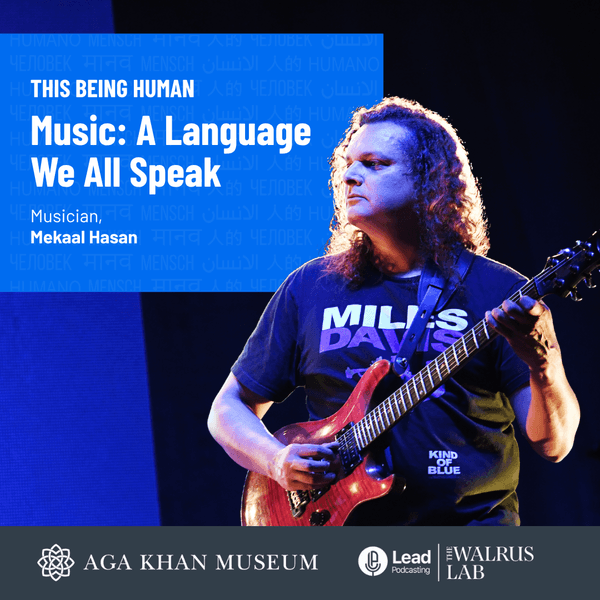
This Being Human - Mekaal Hasan
Mekaal Hasan is a Pakistani musician best known for founding the Mekaal Hasan Band and for his recording, audio mixing and production work.
He founded the Mekaal Hasan Band in 2001 to promote traditional music in the modern world. Working alongside top local and international artists, the Mekaal Hasan Band has been praised across the globe as one of the top Sufi rock ensembles.
The Museum wishes to thank Nadir and Shabin Mohamed for their founding support of This Being Human.
Show Notes
“I don’t want perfect. Perfect is boring.”
In this episode of This Being Human, host Mai Habib chats with Mekaal Hasan, a renowned Pakistani musician to discuss his lifelong journey of connecting the worlds of traditional South Asian music with more contemporary genres like rock, jazz, and fusion.
Growing up in Lahore, Pakistan, Mekaal was heavily influenced by his father, a music critic and a columnist. In 1995, he graduated from the Berklee College of Music in Boston, Massachusetts, and returned to Pakistan where he founded the Mekaal Hasan Band in 2001.
Mekaal’s mission is to create music that connects cultures, lifts up other artists, and preserves tradition while redefining what Qawwali music can look like.
Links & Resources
- This was just one example of Muslim art that sparked curiosity and a great conversation. There is so much more to see at the Aga Khan Museum. Support the Museum’s vision to impact lives and contribute to more inclusive and peaceful societies. Go to agakhanmuseum.org to plan your visit or make a donation.
- Visit Mekaal Hasan’s website and watch his band on YouTube.
- Mekaal Hasan | Aga Khan Museum
- Why Mekaal Hasan refuses to live in the past.
Visit the Aga Khan Museum’s website or follow us on Facebook and Instagram.
If you enjoyed this episode and want to learn more, go to agakhanmuseum.org/thisbeinghuman.
Mai Habib 0:18
I’m Mai Habib, and welcome to This Being Human, an Aga Khan Museum podcast about Muslim art, global cultures and how we’re all connected. There are few things that bring us together quite like music. For centuries, melodies and rhythms have carried stories across borders and sparked curiosity about distant places, and they’ve created connections where words sometimes fall short. Today, we’re speaking to someone who has dedicated his life to just that. Renowned Pakistani musician, Mekaal Hasan. After studying jazz composition in the US in the early 90s, Mekaal returned to Pakistan and founded the Mekaal Hasan Band, a project that would redefine contemporary fusion music in the region. Over the past 25 years, he and his band have brought a distinctive mix of traditional South Asian sounds and contemporary genres to audiences across Pakistan and the world. To talk about his life devoted to music, he joins us now. Mekaal, welcome to This Being Human. We’re so excited to have you on.
Mekaal Hasan 1:17
Such a pleasure being here. Thank you.
Mai Habib 1:19
Mekaal, much of your work is based on traditional Pakistani music like Qawwali, but you majored in jazz composition, and you’ve also worked with rock bands and pop musicians. So take us to the place… When you sit down to create, are you thinking like a traditionalist, a jazz composer, or maybe something else completely?
Mekaal Hasan 1:40
It kind of depends what the intent is. With a lot of traditional music, it starts with, there’s some kind of storytelling aspect. So you have to be careful with what kind of song you pick, what story it’s telling, and then how it’s delivered. Because some of these traditional songs have… Some are more popular than others, right? So some have been done for like, millions of times, millions of people have done them. So there’s got to be a really good reason why you would do that one song with one particular voice.
So whenever I find the right cast of people, it’s kind of like a director, right? When you find that right cast, then you write material which suits everybody and brings out the best in them. So it varies project to project. So for something like what we do… The earlier stuff we were doing was very traditional classical-based. This current project is different from that, because classical music and Qawwali music are slightly different. They’re two different genres. So you have to find the right cast of players, and when you find those voices, or you find those musicians, then something starts to happen. So, you know, it totally depends on the person and what you’re trying to achieve, and the kind of story or impact or objective that you have. So you’d pick people accordingly.
Mai Habib 2:57
Take us back to a younger Mekaal. You know, you’re a Pakistani musician. You attended the Berklee College of Music. In fact, the first Pakistani musician to attend the prestigious Berklee College of Music. How did you end up… This is early 90s. How did you end up there? And I mean, was that the first time you had come to the US? And what was that experience like?
Mekaal Hasan 3:19
I had once traveled to the US in ‘82. So it really starts with my parents. My father was a music critic and a columnist, and he ran an ad agency out of Lahore. And he loved music, and he also had a prolific jazz show, which had every era imaginable covered, from Dixieland to Swing to Ragtime to, you know, the big bands of the day, and then on to Miles & Monk. And so I grew up surrounded by these names and these sounds, and it was a bit bizarre. This is not the normal path for most Pakistani people. There’s not much of a recognition of jazz as an art form in Pakistan, because that influence over the years went away when the British left and they left India and Pakistan. They left behind their instruments and some other traditions, but people kind of reverted back to a more basic kind of life, and so Western life started seeming more remote, because those people no longer lived in the country. Because I live here, I understand that I’m based in a country which is not very globally, culturally connected, and so to me, that means that there’s an opportunity to bring some music to share with people, because it hasn’t been done that much. It’s hardly been done.
Mai Habib 4:54
When you attended Berklee, did you bring that with you? Were you just trying to absorb what was there?
Mekaal Hasan 5:00
Man, I knew nothing about my own country and my own music, but I learned that over there. I would run into people from Argentina, from Spain, from Mexico, from Japan, Korea, all these different nationalities, and all of them had, you know, musicians who were local legends, who they listened to. And so I ended up hearing about people like Astor Piazzolla. I would never have done that if I’d lived in Pakistan. There’s no way. Would never have heard him, you know. And then my roommate was a fantastic writer and guitar player, and he got me into Weather Report and Mahavishnu Orchestra. And I’ve kind of been leaning towards that, because I was into more guitar oriented stuff when I was a teenager, so I was already headed towards that kind of music. But these guys really sort of influenced me in terms of how I thought about composition. Because we were all composition people, so we all used to enjoy each other’s writing as well, and I was totally new to it, so I liked everybody’s writing. And then, I would ask people, “Hey, what do you listen to?” And so the education in Berklee wasn’t the classes, it was actually the people that I network with.
Mai Habib 6:14
That’s a big part of the education. You’re getting, yes, the form and theory and everything. But it’s… Especially in an art form like music…
Mekaal Hasan 6:21
It’s all about getting along with people and just being part of the musical dialogue and not being the only dialogue.
Mai Habib 6:29
And speaking of education. So, fun fact about you is, even though you went to Berklee College of Music. Before that, you did your undergrad in literature with a minor in economics. How has that intersected your music? If at all?
Mekaal Hasan 6:45
I was exposed to a lot of Keats and Shakespeare, and then earlier literature like Chaucer, and then more contemporary writers like Beckett and Pinter. So I had all these schools of thoughts that I was aware of, and then I started looking for those ideas in my own homeland stories and writers and philosophers, and the human condition is essentially the same everywhere. It doesn’t matter if you’re in Pakistan or you’re in Canada.
Mai Habib 7:11
Yeah.
Mekaal Hasan 7:12
Same problems, right? And so what differentiates us from other animals is the fact that we can create and find creative ways to deal with our stories and to sort of express ourselves. So that kind of fascinated me, that there’s so much beautiful things in the world, and every culture has experienced this, but there’s so little connectivity when we want to explain those things to other people. It’s almost like we’re talking to them like they can’t understand, like they’re children. And so I find that a bit… That music is the one thing that can actually help that because you don’t need to speak a particular language to understand emotion.
Mai Habib 7:53
I love that because it really does break barriers, and it breaks cultural barriers, and your music, especially with it fusing so many cultures anyways, it already breaks that barrier naturally, you know?
Mekaal Hasan 8:05
It’s just the way you think about these things. Because, see, the thing is, if music is meant to communicate and to sort of make people feel and think, then it can also be used in a very negative way. And that’s what is the problem with modern music, that it’s used to just tap into quick fixes. And, you know, people want to have hit songs and everything’s a hook, which means nothing’s a hook, like nothing remains memorable when everything is designed to be super hooky and super catchy. So the problem right now is that people have stopped writing because they love it. In fact, people don’t write. That’s the problem in modern… What I see now is people are looking to sort of copy other things, rather than, okay, we don’t have to copy things, but you just look at how people before you, what kind of mindset they had. I picked up… All this approach, I picked up from musicians. And this has nothing to do with the technicalities of music, but it has something to do with how you look at things around you, like, you know, you’re a part of this thing. And artists, unfortunately, have very fragile egos and are very insecure, which is bizarre, because you’re like, well, my job is to express myself, but I’m insecure.
Mai Habib 9:25
For sure, you make yourself vulnerable when you’re putting out your own lyrics, when you’re writing something and expressing something that you’ve been through, there’s a lot of vulnerability.
Mekaal Hasan 9:32
But it doesn’t only have to be emotional things. It can be something deeper than that. It can be more about a way of life or an outlook, or sort of like a perspective which doesn’t necessarily have to… Not all songs have to be about heartbreak or romance, you know. And so much of music that you hear, the common music that you hear are love songs, or songs about relationships gone bad, and very few songs are introspective or about nature or about your own nature. Very few are introspective because people don’t want to look inside. It’s too painful for them.
Mai Habib 10:10
So when you look at your own music collection then, and you know we’re talking about that you’re either falling in love or falling out of love is kind of the general genres out there. How do you feel like you’re… How do you feel like your music fits in that? How many love songs do you have? Versus, like you’re saying, these introspective songs?
Mekaal Hasan 10:27
We don’t have any love songs, as far as I know.
Mai Habib 10:32
That you meant to be a love song anyways.
Mekaal Hasan 10:35
Yeah, yeah. Well, most of these songs, they’re written out of cultural experiences and out of… And some of the poetry, like the Sufi school of thought, the way they would write stuff is that they would place a physical situation, but sort of like, look at it from two different perspectives. Like, there’s the actual thing that’s happening, and then there is the thing that is the feeling inside, which is also happening, you know? So there’s a physical aspect of what’s going on around you, but there’s an internal aspect of what that is making you feel like. So it’s like these two story lines interwoven as one. And so you can talk about the spiritual side of things, or you can talk about the actual physical experience of living in a physical world. So very much like metaphysical poetry.
Mai Habib 11:20
So let’s go back. 1995, so you did your undergrad, you went to the US. You finished Berklee College of Music. It’s 1995 and you say, “Okay, I’m gonna go back to Pakistan.” You know, knowing, like you mentioned, that there wasn’t this fully developed… Like a mature musical landscape.
Mekaal Hasan 11:39
No landscape.
Mai Habib 11:44
There was no land. There wasn’t even a land to scape.
Mekaal Hasan 11:45
Yeah, there was no land. There was no scape. There was nothing. It was just like just starting out. What happened was that Pakistan had gone through a series of dictatorships, and then we had one dictator who actually was not very right wing, but was more moderate, and happened to enjoy arts. During that gentleman’s era, media was encouraged to become more progressive and to sort of reach out to younger people. It was state policy which allowed a lot of music in Pakistan from my generation to be heard because they would allow channels to carry our videos. Before that, we couldn’t even have long hair or wear jeans. It was that bad.
Mai Habib 12:31
Right.
Mekaal Hasan 12:31
Then suddenly you had a guy saying, “You know, it’s okay if kids want to, sort of like play music. It’s good for them. It’s healthy for them. It’s not bad, as long as they’re not doing vulgar songs. What’s the problem?”
Mai Habib 12:40
Looking back at 1995, what you did then, what you could do then, what the music landscape looked then, and what it is today in Pakistan, modern day. What does that progression looked like? Surely, yes, what you’re saying of the political opening to the arts was helpful, but there has also been a natural sort of globalization also. And you know, an expat population that maybe left and then came back, and they bring their influence with them. Just interested in how you’ve seen the landscape move in 25 years.
Mekaal Hasan 13:11
You know, it’s like this whole social media disease that we have now, it’s quick attention. It’s like that dopamine hit. And I think somewhere along the line, the art started getting used to flog these dreams to people, and the advertising sector really impacts the way the arts are used. The problem is we do not have a state policy in Pakistan to protect traditional arts. We have programs, but they’re ineffective.
Mai Habib 13:37
I’m noticing generally outside of music, just generally culturally, there is a pull to go back to more traditional things, the you know, handheld, hard plug, telephone line that only stays at home, right? Like the old TV that only had three channels on it. So I think as more and more, we’re sort of suffocating in this nonstop cycle of like you say these quick hits. People are breaking out and craving the more traditional music, the more traditional arts, ways to live, more connected as a community.
Mekaal Hasan 14:09
All music is actually designed to be in consonance with nature. It’s not designed to be manipulated to sell products. So the music I want to do is the one that aligns itself with something which is pure and from nature. It’s organic, it’s not fixed up, and it’s not perfect. I don’t want perfect. Perfect is boring.
Mai Habib 14:32
I know that you are so devoted to supporting up and coming artists. You were, you know, recently a judge on Pakistani Idol. And for those of you tuning in, it is literally American Idol, Canadian Idol, but in Pakistan, right? What was that like and what was it like, especially in a context of bringing up young talent in Pakistan?
Mekaal Hasan 14:55
It’s not just young talent that needs to be nurtured. It’s actually the older talent which needs to be nurtured more. And I’ll tell you why, because they are the ones who struggled and have the experience, who can impart practical knowledge. Music is not just something that we read. It’s something that you follow instruction, you know, like learning a language, like if we were to speak, if I was learning French, if I didn’t ever speak it and I just read it, there’s no way I’d ever be fluent at it. So music is the same thing, you know? So it’s a language that we all speak, but how we use it and what we say with it, that’s a sensitive issue, for me. For other people, they don’t think about it. They think he’s insane.
Mai Habib 15:35
Nusrat Fateh Ali Khan, you know, he has this iconic record of Night Song. And…
Mekaal Hasan 15:43
Yeah.
Mai Habib 15:44
Talk us through that project. Talk us through how that project all came alive for you.
Mekaal Hasan 15:48
For people who don’t know about Nusrat Fateh Ali Khan, he’s a very important cultural figure for Pakistan, and I would say, generally, for world music. He’s important because he was not only a fantastic Qawwali artist, but his compositions found so much wide scale acceptance amongst audiences and other artists that it’s almost like he wrote a book on what is possible in Qawwali. So there’s like, a huge debt that people owe to Nusrat, because he really popularized that art form, and he’s the most recent giant from our cultural landscape who is still in living memory, like our generation and the generation which is older than me. We all remember hearing and seeing Nusrat, but the younger people coming in, they may have heard his name, they may even have heard his songs, but they may not know it’s him.
So when I had a residency in 2023 at the Aga Khan Museum, and at that point, I brought in the classical based music that I was doing prior to the whole Nusrat idea. And once that was done, I asked Amir Ali that, you know what music or art you have here from Pakistan? And he said, Well, actually, you know, we have a lot of stuff from Rumi, but I don’t know about Pakistan. So I was like, “Why don’t you let me create a tribute to Nusrat, because his legacy, people will remember it in Canada, there’s enough Indians, Pakistanis, Bangladeshis, who will be familiar with his work, and they would love to hear his music.”
Mekaal Hasan 17:36
[Clip of Night Song plays]
Now, keep in mind that Qawwali artists sing Nusrat all the time, but the way this guy that I had in mind, he’s got the closest range and power to Nusrat. So I knew I had someone I could develop for this kind of project.
Mekaal Hasan 18:33
It was the first time he came to Canada, Shahzad Ali Khan, to sing. So I just wanted to have that freshness and immediacy there for both sides. So basically, that’s how we brought the thing together. I was like, you know, every person wants to come to Canada and immigrate here and then, you know, apply for grants or whatever. But I don’t want to take that route. I want to come in here with something and then give people a really profound experience so that they won’t forget it, because people don’t forget the way you make them feel.
Mai Habib 19:07
How did you feel? How does it make you feel that what you brought with you to Canada was to re-interpret somebody as legendary as Nusrat?
Mekaal Hasan 19:17
A pretty stiff challenge actually, was when they did Night Song. When we spoke to Michael Brook, the guy who produced it, Michael Brook said that they never toured with the record, really, they just put it together in the studio, and they did it like piecemeal, like he would sing, Nusrat would sing a bunch of things. They would then take the recordings, then come up with parts around what he had done. So they never really sat in a room and played it, which is how we did. We came up with arrangements and parts and sections, just the way a band does. So that was kind of cool that we got to actually play something which they had put together but not toured with, and we actually toured with it.
19:55
[Clip of Night Song plays]
Mai Habib 20:18
And now you’ve performed in, like we’ve talked about the sort of Indian subcontinent, in India, in Pakistan, but you’ve also performed in Western countries, right? Like Canada, we just talked about.
Mekaal Hasan 20:30
Yeah.
Mai Habib 20:31
How do you feel, if there is a difference, in how your music is received in Pakistan versus within the diaspora in Western countries. Is there a difference? And what do you notice?
Mekaal Hasan 20:43
People who were going to college when I was coming up, when I was 26, 27, those people are now in their 40s or 50s, and they’re either business owners or… But they have very strong, emotional memories with this music. So that’s an audience that I keep finding, whether I’m in New York or Toronto or the UK, it’s like there’s a generation of people who’ve been influenced by that music. But because I’m not an overtly commercial artist, I’m not a corporate star, those people will always be sort of a niche audience, but it’s a very loyal niche audience,
Mai Habib 21:20
Qawwali, so this traditional, like you said, the Sufi music from the Indian subcontinent, is traditionally performed while sitting, right?
Mekaal Hasan 21:29
Yes.
Mai Habib 21:30
And there was this one performance, or this one song, anyways, at the Lahore Jazz Club, where you’re standing, you and some others are standing with the guitar and so that’s a very traditional Western way of presenting music. It is very rare that Western artists are sitting on a floor to present but then in between you is this array of Qawwali artists all sitting, and just the juxtaposition of the experience of not just the music itself that is juxtaposed, bringing the west and the east, but even the physical how it’s laid out. So talk to me about that and the physical experience there.
Mekaal Hasan 22:10
The reason Qawwali became popular is that this is how early Islam was spread through the Indian subcontinent, through song. The Muslims noticed that the Indians had Bhajans, which are devotional songs, and those would attract people who were curious about what they were singing about, you know? So they picked that idea from the local Indians, and they started crafting religious text or religious thought or celebratory sort of songs commemorating auspicious occasions, which could be religious or just cultural. But they started using that tactic, and that is how Qawwali came to be so popular that it was the every man’s music.
And it’s sort of rooted like gospel music and church music, that there is a call and response thing happening with Qawwali, as it does with gospel music, that there’s a preacher and a congregation, and the preacher testifies, and the congregation backs him up, and the crowd sort of backs up the congregation, and they all sing together. This is exactly the same thing in Qawwali. That the lead singer will testify and the secondary singers and the group will be the chorus. And then there’s a back and forth that happens. And oftentimes, when they do Qawwali shows, they’ll pick a piece of poetry, and when people start enjoying that line, they’ll keep repeating it, so it’s almost like a hypnotic thing, and then they’ll go into another line, and you know? So it’s like this, back and forth between the crowd and the Qawwals, right? Now, this is very different from the normal, traditional, classical thing, where it’s a performance that you are supposed to, sort of like passively take in. You don’t really participate. You’re very quiet and respectfully listen very intently, because that medium is about a devotional thing, but it’s about an intimate devotion. This is about the crowd celebration. So it’s a completely different feel. This is more wild and more celebratory, much more sort of flamboyant, you know, it’s not as subtle as classical music. It’s much louder. So imagine it’s like a blues version of what you know Western music is. This is our blues version.
Mai Habib 24:35
That’s the blues, yeah, where it’s really in your feelings, and you can really feel it when you’re listening to it, you really do.
Mekaal Hasan 24:40
Yeah.
Mai Habib 24:41
There is a physical movement when you’re listening to Qawwali.
Mekaal Hasan 24:45
So it’s the same thing when you sing hymns in the church with the whole congregation sings. It sounds weird if it’s one person singing, but suddenly you’ve got 100 people singing, the feeling completely changes.
Mai Habib 24:55
You’re right. It’s an immersive, immersive experience, for sure.
Mekaal Hasan 25:00
[Clip of Night Song plays]
Yeah, not just the performance. It’s like you are part of the performance. So this is what happens in kawaii. You become part of the thing.
Mai Habib 25:32
So you have a few hit songs, but you don’t want to be just the “Hit Song Guy.” What does the future of the Mekaal Hasan Band look like? Are you exploring new genres? Are you doing more international collaborations?
Mekaal Hasan 25:47
The thing is, as musicians, we have to be very flexible with our talents. So this production work that you can do, you can write for film, you can… You know, there’s other experiences that music can give you. You can write sports anthems. In fact, I just did one. But what I’m saying is that as musicians, there’s that one thing that you really want to do, and then there’s the craft of what you do, which can be used to help other people realize what they want to do. So I’ve been focusing in the later part of my career, more about using my experience to just work with other people and help them.
Mai Habib 26:22
Yeah, I can. I mean, you’re embarking on what you never had, right? Like you didn’t have somebody to pull you up.
Mekaal Hasan 26:27
You know, man, your time on the planet is not forever, so someone’s life should be better because of you. That’s a pretty decent way to go.
Mai Habib 26:36
This has been just such a fascinating conversation. We’re so excited to get it out to the audience.
Mekaal Hasan 26:41
Thank you so much. It’s been amazing talking to you, and I hope you can discover some of our work, and I’m looking forward to hearing from you guys.
Mai Habib 26:51
This Being Human is brought to you by the Aga Khan Museum, a place where centuries of art inspire new conversations, like you heard today, every day. This podcast is produced by Jules Ownby and edited by Zia Khalid. Amanda Cupido is our Executive Producer. I’m Mai Habib. If you enjoyed this episode of This Being Human, be sure to hit that follow button to catch the next episode available on YouTube and wherever you get your podcasts.