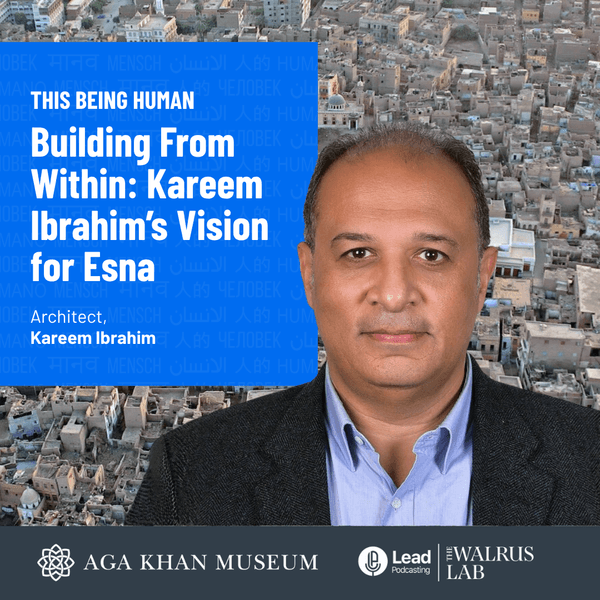
This Being Human - Kareem Ibrahim
Kareem Ibrahim is an Egyptian architect, urban development expert, and co-founder and CEO of Takween Integrated Community Development. His work spans heritage conservation, inclusive urban revitalization, community development and urban policy. In 2025, Takween’s Revitalization of Historic Esna project received an Aga Khan Award for Architecture for its approach to preserving the city’s heritage while supporting local economic and community development.
The Museum wishes to thank Nadir and Shabin Mohamed for their founding support of This Being Human.
Show Notes
What does it take to bring new life to a city without erasing what made it special in the first place?
In Esna, a historic city along the Nile, architect Kareem Ibrahim and his team have spent years finding out. Their approach starts not with buildings, but with the people already there: local craftspeople, business owners, traditions and knowledge that can easily be overlooked when cities are redeveloped.
In this episode of This Being Human, Mai Habib speaks with Kareem about the long, sometimes messy work of earning a community’s trust, and how that process helped transform Esna into an award-winning model for heritage and tourism in Egypt. They also trace the unlikely story of Okra, a cooking competition that grew into a women-run restaurant attracting visitors from around the world.
It’s a conversation about what can happen when preservation means more than protecting old buildings—and when the future of a place is built from what is already there.
Links & Resources
- This was just one example of Muslim art that sparked curiosity and a great conversation. There is so much more to see at the Aga Khan Museum. Support the Museum’s vision to impact lives and contribute to more inclusive and peaceful societies. Go to agakhanmuseum.org to plan your visit or make a donation.
- You can find more about Takween Integrated Community Development and its projects online and on Instagram.
- For a taste of Esna, be sure to look into Okra, the restaurant in Esna entirely operated by local women.
- Check out more episodes in full video.
Visit the Aga Khan Museum’s website or follow us on Facebook and Instagram.
If you enjoyed this episode and want to learn more, go to agakhanmuseum.org/thisbeinghuman.
Mai Habib [00:00:21] I’m Mai Habib. Welcome to This Being Human, an Aga Khan Museum podcast about Muslim art, global cultures, and how we’re all connected. Few countries are more steeped in history than Egypt. From the pyramids of Giza and the Great Sphinx to the twists and turns of the Nile River to Luxor, Egypt has long been a land of creativity and great human achievement. Architect Kareem Ibrahim not only helps preserve that remarkable history, but also works to develop projects that improve the lives of people living in Egypt today. Kareem, welcome to This Being Human. It’s such a pleasure to have you on. And full disclosure to our listeners, my family is Egyptian and immigrated to Canada, so this one is particularly personal for me.
Kareem Ibrahim [00:01:03] Thank you for hosting me on this podcast, which is a real pleasure.
Mai Habib [00:01:09] You and your firm, Takween, won the 2025 Aga Khan Architecture Award for the revitalization of the historic city, Esna, which basically sits on the West Bank of the Nile and, kind of, southern Egypt, which ironically is called Upper Egypt, from the ancient days. So first of all, congratulations on this amazing award. For listeners who haven’t been there… Tell us what Esna is like. Paint that picture. What makes this town so historically significant, and why did you pick it for this revitalization?
Kareem Ibrahim [00:01:40] Esna is more of a provincial city. It’s something that sits in between a large village and a small town. And it’s located on a very important path along the Nile, between Luxor and Aswan, where a few cities are there, mostly on the West Bank of the Nile. And so it’s located almost 60 kilometres to the south of Luxor. And at some point in time, this city was even more important than Luxor itself. It dates back to ancient Egyptian time, and it witnessed a lot of layers of history that sit together from the ancient Egyptian period to the Greco-Roman era to the Coptic era, and then to modern history. So it’s a very multi-layered city in terms of what it accumulates, in terms of history and evidence of this history, in terms of building and traditions and so on. And we didn’t pick Esna, Esna picked us, actually. So somehow, by something called the Informal Settlements Development Facility, back in 2009, which was a fund that was established by the Egyptian state to deal with areas where unsafe conditions exist. I’m talking about physical conditions in terms of precarious neighbourhoods or areas that are subject to some kind of threat. This fund was established by the Egyptian state back in 2008, and one year after they had been established they wanted to show some demonstration projects how to deal with different types of fabric. Our firm, and our group of architects and social development workers, were very well known for dealing with historic cities and dealing with, let’s say, complex situations of integration between social, economic, and physical aspects. So they picked us. They actually had hunted us to come and work on the city. That was my first time going there because many people think that I come from this city. That was not a fact. The first time I saw it was back in 2009, and we fell in love with the city when we went there. There’s a great potential for it because it’s something that encapsulates Egyptian history in one place. That’s how we saw it.
Mai Habib [00:04:00] That’s so interesting. And you touched on this a little bit, but maybe expand… What did that initial mandate for you look like in 2009 for this project, and what does that take to revitalize such a historic city?
Kareem Ibrahim [00:04:16] So the initial mandate was to put up a plan for revitalization with a span of four to six years of implementation. And there have been different views about this city at that point of time. One is to demolish everything and expose the temple. Another to work on a gradual upgrading of the city itself and its fabric, especially considering the different buildings surrounding the temple. And you need to imagine with me… This is a city with a very unique setup. It’s like, you go into an urban fabric, and at the heart of the city, where people live, there is a temple, and everybody has life surrounded, which is very unique in an actual situation. And for us, we saw an opportunity in the city because, as I said, it’s very rare, even though the very long history of Egypt… But to find all these layers of history in one place, it’s almost like 80 acres. That’s it. In one place, it was this concentration of heritage buildings, traditions like handicrafts and so on. In one place was really stunning. So for us, to come up with a plan that integrates the social, physical and economic sides of development altogether… To do that, what it takes to work on such projects… Number one, you need a hell amount of patience. You need to be very patient.
Mai Habib [00:05:40] Right.
Kareem Ibrahim [00:05:41] You need perseverance, you know, because…
Mai Habib [00:05:45] Right. Consensus building is not an easy task.
Kareem Ibrahim [00:05:46] And you need to be resourceful. And so, these are the three qualities of, I think, anybody who is working in this field. It doesn’t matter what your background is, actually, but definitely you need to have some kind of understanding of how to deal with historic fabrics. But these are like living fabrics, and the whole issue is not the physical intervention, it’s to come up with a consensus, a vision, that’s actually shared between the different stakeholders and players in this game, about the future of the city, the future of this heritage. And I think it’s needed… Again, you need to be very patient, you need to be very resilient, and a lot of perseverance to do that.
Mai Habib [00:06:32] So it’s interesting, the consensus building part, because I know you take this approach, and you have said, you know, for development to be truly successful, you need to have community involvement and sustainability. Why are these two elements so important, and how did they come together in Esna?
Kareem Ibrahim [00:06:52] I’m not a big fan of the term sustainability. People overuse it. And in fact, it doesn’t tell you which sustainable direction you’re going into. You can go into a sustainable famine or a sustainable genocide, for example, you know. So in itself, it’s not a positive or a negative connotation. What’s important for us is inclusion and morality. And so you need to have a sustainable process, but at the same time, it needs to be inclusive of the community. It needs to be plural in terms of what it brings together, in terms of social classes, of different backgrounds, of economic classes, and so on. And I think this is the most difficult part because you can develop a historic area. And we have so many examples around the world where the entire community is gentrified. Everybody leaves and nobody benefits, maybe some expats or people living abroad benefit from that. And it’s still sustainable because it’s financially sustainable. But in terms of socially, economically, environmentally… There are different aspects that you need to consider, and for us, inclusion was key. We put a lot of lines below the word inclusion because this is a difficult part, because you need to break up with a lot of practices, you need to break up with a lot of, let’s say, common wisdom about this sector especially. I think the breakthrough we’ve been able to make is to somehow shake the boat about what they used to do in Egypt about that.
Mai Habib [00:08:23] Okay, let’s pick up on inclusion a little bit, right? Like your firm is based out of Cairo. You get this mandate, and you said your first time to go to Esna was in 2009. And, you know, Esna is in As-Sa’id, right. A part of Egypt that tends to be very rural. I think you had touched on the socio-economic challenges that may be present in some of these areas. What was that like? What was the inclusion journey like for you to kind of come in and build that trust? Like the word trust just keeps coming to mind, of the locals and how you built that trust between them so that they can let you in, so that they can be a part of that process, and you can build that consensus.
Kareem Ibrahim [00:09:07] That was built on, like, a mountain of failures. Like, one after another. So yeah, that’s why I told you, you have to be patient. Yeah, and throughout this project, you need to know something… The Esna project is one out of almost, like, 110 other projects we implemented in Egypt, so it builds upon a lot of know-how and failures and lessons learned from other projects, even before we established our company. So, in this project, we had to test and reshape our approaches, and to rethink them, actually, along the process. So, let me give a couple of examples. We are very well-known in the Egyptian, let’s say, ecosystem of being a firm that is very adamant on community participation. So, that’s a key tool. We’re one of the very first organizations in Egypt that has been so consistent in using participation in all our projects. But when we started working in Esna, this didn’t work. You know, the first community sessions we had, everything blew in our face because people were so stressed and they felt neglected for years and… There is always this tendency even among the government officials of people coming in conducting a study and leaving, you know, and using the community as a case study, and so on. So people were very frustrated, and they were telling us, no, we won’t be cooperating with you because we have been promised, pretty much, of things having to change or nothing change. So we said, fine, let’s stop anything that has to do with participation. Let’s go and implement something on the field first to build this trust. It took us two years to build the trust, okay. And when they saw us working in the field, implementing interventions that haven’t been done before, with the antiquities, with the Luxor Governorate, with the community, they started trusting us. And we’re so proud of this partnership, like, we’re so glad that we had the Ministry of Tourism and Antiquities on board, the Governorate of Luxor. Just to say now, the Egyptian state is pumping into Islam something in the neighbourhood of 10 million US dollars, half a billion Egyptian pounds of investments, in the city, to actually promote the same approach within the city. And this is something this kind of consensus building helped to do. That’s one thing. Another thing is that we had smaller projects within the project dealing with retail shops, bazaars, gastronomy, accommodation, and so on. This project evolved and we evolved with it, you know, as people, as persons, as professionals, to the extent that it made us establish three sister companies to date, after this project. Because of what we saw, how we can work in a more efficient manner, a more, let’s say, rooted and more practical and pragmatic way of pursuing development in communities like this, without needing to rely on donor funding as we used to do.
Mai Habib [00:12:13] And I had heard you even say that part of the process was to source… So sourcing the labour locally, you know, empowering local people, and also sourcing materials and resources locally as well, right?
Kareem Ibrahim [00:12:27] That’s a philosophy we’re following in all our projects, is that, we are saying that there is no zero in development. So it’s basically wherever you go, you need to pay the existing assets respect in terms of material, people, know-how, knowledge, and so on. 100% reliance on local labour. That’s what we did. So actually, we worked with more than 500 craftsmen. And another thing to show during the project is that its improvements, and improvement of quality of life, is not something that’s promised beyond the lifetime of the project, it can happen now. By relying on local resources, local materials, we secured more than a quarter a million man-days of work within the city, 250,000 man-days. And we recycled tonnes of materials. So it’s basically half a million bricks that have been recycled. Mud bricks, a lot of, like, wooden joists and wooden elements, and so on, to show that local assets count. And this is something we can build on. And if we look at it with the right perspective, we can do miracles with it.
Mai Habib [00:13:31] Another local project, which I’m particularly excited to talk to you about is economic opportunities for women, too, for the local women. And I understand that you and your partners brought, like, a master-chef-type, what they thought was a master-chef-type, competition down there. Which, speaking of sustainability and a positive connotation, ended up being a restaurant, right, named Okra? Tell me, okay. Talk me through the journey of Okra and the local women getting involved.
Kareem Ibrahim [00:13:59] So let me give you some perspective or background about it. So one of the innovative tools we use is something called the local tourist value chain mapping. So it’s basically… We take a journey of a visitor, whether it’s an Egyptian or a foreigner or whatever, and we just think how this visitor perceives the city, how he knows about the city, or she knows about this city, for the first date. How would we come to the city, and who takes them around. Who actually provides the most accommodation, meals, and stuff like that. And by doing this mapping, which was done for the first time in the Egyptian context, we’ve been able to identify opportunities for the community to become part of the tourist value chain. This is how we made it inclusive. So gastronomy was a big thing because we, as professionals working in the city, we were suffering ourselves, so finding a place to eat or to sleep or whatever. The whole story began with a great lady, working with us at the office now, who used to cook us an amazing lentil soup and… We said, fine, let’s institutionalize this. We need this to become a business, and we need women to be part of it, because part of our effort was how to make gender aspects penetrate the tourism value chain. Women have very, very, very little share in the tourism industry in Egypt, and what we try to do is to think of ways where they can play different roles, away from being, like, an employee or something like this, but become even business owners within this spectrum. We worked on identifying the different recipes in the city, what traditional types of food they used to eat and so on, and this didn’t work. This was the classical approach of going, knocking on doors and asking people, interviewing them. And this was a bit slow, so we had to innovate something. That’s one of the innovations that took place in the project. And we said, fine, the quickest way to do it is, a colleague of mine said, let’s have a cooking competition and invite everyone in the city to participate. And this was crazy, you know, because we didn’t imagine the amount of applicants and people, like really, the hype in the city of having something like this which never happened before… So we had access to all these social media pages in the city. We announced the competition, and it had two simple conditions. One is they should cook a three-course meal. And second, this meal should be all based on Esna’s gastronomic tradition.
Mai Habib [00:16:46] Okay.
Kareem Ibrahim [00:16:49] And I think we received more than 80 ladies. And they were not coming alone, they were coming with all their families.
Mai Habib [00:16:55] They need the cheer squad, of course.
Kareem Ibrahim [00:16:57] So we had to rent a big space for people to come in and so on. And I think 42 ladies passed through, and, actually, they were qualified because they had things to do with Esna. So the first round, out the 42 ladies, I think 13 ladies qualified for the second phase. And when we took it further to Luxor, to a very prominent hotel over there, where we brought in, like, a MasterChef from Cairo or MasterChef from Luxor. And there was an audience, and people from the government, and it was a big thing, actually, that was really covered. And three women won the competition. So that was the competition side, but we had two different agendas, actually, beyond that. One was to identify a number of ladies who had never been working as professional cooks before, and to identify the recipes that they know. So in a very short time, we’ve been able to document 25 recipes that we didn’t know about. We launched, I think in September 2024… That was the launch. And they presented their first meal during that month as well, I think, as far as I remember. So it’s basically… And we came up with an idea that we’re testing in Okra, and other businesses as well, with women, because that’s not the only business that we are having with women over there, is to have a partnership, a community partnership. And we said, fine, let’s see what women can do within this partnership, and what we can offer. And we have a long-term relationship where we have a fair deal between us. So whatever the proceeds of Okra are until today, which is financially sustainable from day one…
Mai Habib [00:18:45] Fantastic.
Kareem Ibrahim [00:18:46] It’s a 50-50 partnership. So the lead, the management of the kitchen–
Mai Habib [00:18:52] The ladies, the local ladies.
Kareem Ibrahim [00:18:53] The ladies. We don’t exist. We’re non-existent. If you go there, you don’t find this. We work on issues of quality control. We work on issues of marketing and promotion, and so on, and interfacing with other businesses. They manage everything from the inside. So we don’t exist in the kitchen, in fact. And we split the proceeds. That’s it. Like deducting the cost and so on. And it’s a very fruitful partnership because they are owners of the place. On the other side, we take care of issues that have to do with, like, legal compliance, taxation, and so on. Whatever has to do with running a business. So everyone brings to the table what they know. It’s a very successful experience. We have more than 70 five-star reviews. We didn’t even get a four-star review yet, but we…
Mai Habib [00:19:40] Wow, okay.
Kareem Ibrahim [00:19:41] It’s a very successful business. And later on, it became like an attraction in itself. So we find people calling us from New York, for example, we’re going to celebrate this, let’s say, fashion designer coming into Egypt and she wants to eat at the restaurant. She doesn’t know about Esna. And that’s the funny thing. We started receiving bookings and people coming in without knowing the city. They just come to the kitchen, okay.
Mai Habib [00:20:04] For this restaurant, for this woman-owned restaurant.
Kareem Ibrahim [00:20:06] And then later on discovering, okay, there is a historic city around it, there’s a temple nearby… They started exploring the city. We heard a lot about food being the number one motivation in cultural tourism nowadays, but we saw it in the happening. We have experiences… You can come and have an experience with a local lady that takes you around, but she’s now featured in the Lonely Planet.
Mai Habib [00:20:32] I saw her. I saw her tour… That she’s, like, a tour guide extraordinaire. I’ve seen that.
Kareem Ibrahim [00:20:37] Yeah, yeah, yeah. It was amazing, you know.
Mai Habib [00:20:41] So, okay, I also heard somebody local say, and he said it in Arabic, but I’ll translate loosely in English, is that Esna was like a forgotten city. Nobody really even knew it existed. And that Takween, your company, was able to come and, like, polish it off, right? Like put them back on the map. What does this mean for, like, the future of Egyptian tourism? How do you see Esna as, like, almost, I think I’ve heard you say test lab for the future of Egyptian tourism. Where does that model fit in?
Kareem Ibrahim [00:21:15] If you have a compassionate eye looking at local assets, you can do a lot of stuff without needing leisure investments and so on. Just the perspective of looking at things. And that we shouldn’t be ashamed of our local identity in terms of, like, wearing a galabeya or, like, the type of food we’re eating or, like, sitting in a coffee shop. This local feel and local experience, it both boosts the local pride and esteem, and at the same time it complies with whatever modern trends about tourism right now, because people need to interact with other civilizations, other cultures, and so on. And this is the key thing about cultural tourism. It’s not about sightseeing. It’s about interacting with people. In Esna, for example, we managed to quadruple, or actually multiply the number of visitors by five, within the lifetime of the project. During the first years, we tripled the number of visitors to the city. And definitely, they spend more right now or change how Esna is being perceived within the local context among tour operators. So all of these things have proven that it can be like a working model for other places.
Mai Habib [00:22:26] And to empower the local people, right? It’s a proven model that local people empowerment, that inclusive pluralism, does work.
Kareem Ibrahim [00:22:34] Yeah. And the thing that we’re trying to communicate to others is not a charity approach or, like, being nice to the community. It’s good for the business as well. That’s what we are trying to convey as a message. If you’re a tour operator or a company working in this field, your clients are going to be, actually, more appreciative and willing to invest more if you’re buying in this kind of experience. So it’s a win-win situation to all. That’s the thing. We’re not asking them to donate something to the community, or something like this. Or even, you have to accept this low quality product because it’s coming from the community and so on. We’re upholding the community also to the standards that people expect as well, so it goes both ways, actually. So it’s not about, accept anything that the community provides you. No, the community needs to understand as well that people have expectations, and there should be some consistency, some acceptable level of quality, and to be fair to the visitors. So basically, it goes both ways, and it’s good for the business.
Mai Habib [00:23:32] Absolutely. Yeah, that authentic experience. So, your company is based out of Cairo. You’re based out of Cairo. And Cairo itself, despite being, you know, a humongous city, it has a lot of informal neighbourhoods, and I know that you work locally there, too. And, you know, just for our listeners who don’t know, there’s sort of the Greater Cairo area. The population is about twenty three million and counting. And there are rough estimates of, you know, anywhere from 40 to 70% of these informal communities. So what are these, and how are you going in to support?
Kareem Ibrahim [00:24:11] Informal somehow is understood of areas that have developed outside of the parameters of the planning law, which are somehow now called, like, unplanned areas. To me, there are areas in need. So they are in need of, whether housing upgrading or, let’s say, you need to work on the infrastructure or the services or whatever, or even poverty issues. This goes both ways. You can go for a very formal housing neighbourhood, but it has issues with levels of education, services, poverty, access to utilities, access to whatever. So for the last 30 years, we’ve been trying to shift this paradigm of the stigma, actually, of calling an area informal or whatever. There are areas in need. And to do that, we have been working, almost like 70 percent of these hundred projects that we’ve worked on were in what were called informal areas. So to imagine these are large areas of self-built housing, and these are either built on desert land owned by the state that people took over or agricultural land owned by the private owners that they turned into land for construction and so on. So it’s either informal in the ways that people don’t own the land, or they own the land, but they cannot change the use into residential or an urban area. So that’s how they are outside of the parameters of the law, that’s in a nutshell. So we’ve been working on many different levels. One is to implement interventions and direct projects that improve the quality of life within these neighbourhoods, like small parks for women and children, improving the access of, which was an award-winning project as well, to upgrade a tunnel that connects the neighbourhood to the services and people can go to schools, and kids and women can go through markets, and so on, and… You name it, like, upgrading of an existing market and so on. So these were like direct implementation projects where we worked with the community to develop something that fits their needs. The second level is to work on area upgrading programs. And we’ve worked with many international and local agencies of developing, upgrading plans for entire neighbourhoods, which was multi-year programmes of, like, four to 10 years of interventions and so on. So we’ve been working on the plans to upgrade these neighbourhoods. And the third level is at the national level because we also intervene in shifting the way Egypt is handling these neighbourhoods.
Mai Habib [00:26:48] Like in the government, at a government level.
Kareem Ibrahim [00:26:51] Yes, but in a more institutional manner. So we developed the national guidelines for developing what we call local area development plans, which are developing plans for upgrading of existing neighbourhoods. So we develop the national guidelines for that, so the government is using it and all the different options. We’ve developed the national guidelines for gender mainstreaming and urban design and planning. So how can urban design planning become more gender-sensitive? We’re working on, also, national guidelines for climate resilience as well, and dealing with these neighbourhoods. So we’re working like a messenger between an implementation level, very small projects implemented on the ground, to neighbourhood upgrading plans to national policies. So that’s basically how we go up and down, in fact. And this is something we’re very proud of because whatever we advise, this policy is informed by real practice on the ground and vice versa. So it’s basically, we look at the bigger picture when we’re dealing with small products as well. And this is something that’s very unique to our organization in this context.
Mai Habib [00:27:59] Do you, when you look around, I mean, you live there… When you look around Egypt, do you ever get the sense of like, I’ve got much more to go, we’ve got more to do, there’s a lot of work, there’s a lot of opportunity here?
Kareem Ibrahim [00:28:11] Egypt is a very big country, actually, in terms of issues to deal with and potentials and promises as well. And we’re a young country as well, more than 60% of the population are under the age of 30. So there are so many challenges, and we are glad to be part of the solution and to contribute something, even very small, for generations to come, you know. That’s something that many generations will be working on, and if we look at the long-term picture, we’re just like a drop in the ocean of what has been happening here.
Mai Habib [00:28:47] I was going to ask you, what do you want your legacy to be, but it sounds like you already answered that. Everything we talked about today, Kareem, is human impact. You are so focused on the human impact of your work.
Kareem Ibrahim [00:28:59] Impact on people and showing others how to do it. I think that’s important for us. It’s not only about your projects having an impact, but we need to leave behind a way of doing things that others can follow and adopt and copy, and even ameliorate and improve. That’s our hope.
Mai Habib [00:29:19] That’s wonderful, Kareem. Thank you so much for this conversation. Thanks for sharing your time, your insights. Thanks for all you’re doing.
Kareem Ibrahim [00:29:25] Thank you so much, and I wish you best of luck and greetings to everyone.
Mai Habib [00:29:29] This Being Human is brought to you by the Aga Khan Museum, a place where centuries of art inspire new conversations every day. This podcast is produced by Jules Ownby and edited by Zia Khalid. Amanda Cupido is our executive producer. I’m May Habib. If you enjoyed this episode of This Being Human, be sure to hit that follow button to catch the next episode available on YouTube and wherever you get your podcasts.