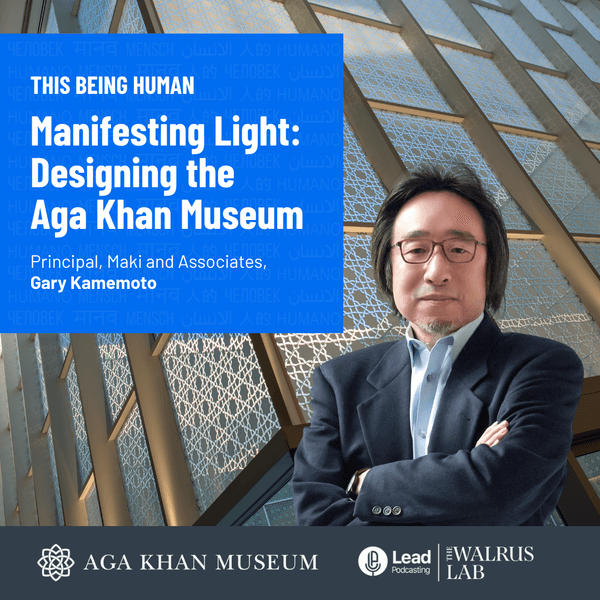
This Being Human - Gary Kamemoto
Gary Kamemoto is a Principal at Maki and Associates and the lead architect behind the Aga Khan Museum in Toronto. He joined the firm in 1984 and has worked on major projects including the MIT Media Lab, 4 World Trade Center, the Aga Khan Centre in London, and the Delegation of the Ismaili Imamat in Ottawa.
Working closely with the late Fumihiko Maki, Gary helped shape the Museum’s design, from its geometry and material choices to its use of light and landscape. His approach to architecture is rooted in precision, craftsmanship, and a deep respect for the cultures and contexts each project inhabits.
The Museum wishes to thank Nadir and Shabin Mohamed for their founding support of This Being Human.
Show Notes
Before the Aga Khan Museum became a landmark in Toronto, it started with a letter about light.
In this episode of This Being Human, host Mai Habib sits down with principal architect Gary Kamemoto, who led the Museum’s design alongside the late Fumihiko Maki. He shares how that single idea—light—shaped everything, from the building’s geometry and materials to the way you move through the space.
Along the way, you get a closer look at the thinking behind the Aga Khan Museum’s architecture, and how it draws on Islamic design and ideas of pluralism to create something that feels both timeless and distinctly contemporary.
Gary also gets into the details you’d likely miss on a first visit: patterns that shift with the sun, geometry hiding in plain sight, and a subtle architectural tribute woven into the building itself—details that, once you know they’re there, change how you see it.
Links & Resources
- This was just one example of Muslim art that sparked curiosity and a great conversation. There is so much more to see at the Aga Khan Museum. Support the museum’s vision to impact lives and contribute to more inclusive and peaceful societies. Go to agakhanmuseum.org/thisbeinghuman to plan your visit or make a donation.
- Read more from Gary Kamemoto on the partnership between Maki and Associates and the AKDN
- Check out more episodes in full video.
Visit the Aga Khan Museum’s website or follow us on Facebook and Instagram.
If you enjoyed this episode and want to learn more, go to agakhanmuseum.org/thisbeinghuman
Mai Habib 0:10
Welcome to This Being Human, an Aga Khan Museum podcast about Muslim art, global cultures and how we’re all connected. I’m your host, Mai Habib. Toronto’s Aga Khan Museum isn’t just home to art, it is a masterpiece in itself, with its luminous white stone, clean geometric lines, tranquil courtyards of reflecting pools and landscaped gardens. Today, we’ll be exploring the vision behind this extraordinary building with principal architect Gary Kamamoto. Gary has shaped landmark buildings like the MIT Media Lab, 4 World Trade Center, the Ismaili delegation building in Ottawa and the Aga Khan Museum in Toronto, under the late founder of Maki and Associates, Fumahiko Maki. Today, he shares the story behind designing this architectural masterpiece, and for those of you listening and curious about the visuals we mentioned throughout the episode, don’t forget you can watch the full video version on YouTube to see everything we’re discussing. Hello Gary, welcome to This Being Human!
Gary Kamemoto 1:16
Hi, Mai. Thank you for this incredible honor to participate in this podcast, to discuss our journey in the making of the Aga Khan Museum, and not only of the building itself, but the vision that His Highness and the Ismaili community had for bringing this project to life.
Mai Habib 1:39
So take us a little bit back, Gary, take us through your background and what truly drew you to architecture to start with.
Gary Kamemoto 1:48
Well, first of all, I’m a Japanese American, and although I’m a product of Japan, I was born and raised here. My education was through an American system. So I was brought up both in both cultures, and somehow I always felt like I was floating in the middle of the Pacific Ocean, not belonging to either country. In Japan, I feel more American, and in America, I feel more Japanese, and I think that maybe duality between East and West, I think still continues, I think in my subconscious and also conscious. I think through the work I do, and what probably attracted me to get into the profession is in recalling my childhood. I really love drawing a lot, and in high school, I got introduced to mechanical drafting. And I think that one thing led to another, and I think this evolutionary process of learning about architecture continued through university work, and then finally, soon after that, I decided to join up with with Maki. So my time here has now… I’m counting years… been 41 years. And I think the more I do, I feel, the less I know about the profession.
Mai Habib 3:29
Okay, and bringing it to the Aga Khan Museum itself, walk us through the museum’s early conception. What was it like shaping the building with the leader of your firm, at the time, Fumihiko Maki, the late Fumihiko Maki, a world renowned architect himself?
Gary Kamemoto 3:46
Well, I think I probably won’t be able to discuss the museum without speaking about the Delegation building, because that preceded our journey for the museum. And that goes back two years earlier than the museum. It started in 2002 when one morning we came in, and at the time, we were still dealing with faxes. So there was a fax from the leader of the Aga Khan Development Network, expressing or soliciting an interest to work and contribute to the Delegation building, in Ottawa. And what surprised us is that when we said that we want to learn more about the project, we actually got a competition brief, and that kind of puzzled us, because we thought, Well, this was soliciting in an interest, but is it in fact, a competition? And then we got a response, saying, no, no, no, it was a competition, but his highness, specifically, wanted Maki and our firm to get engaged in the design and development of the Delegation building. So I happened to be actually at the project you spoke about at the MIT Media Lab. We were carrying that out, and I was based in Boston at the time, so I made a quick visit, and I flew over to Ottawa to understand the project. And obviously it was a fascinating one, because it was the first representational building of His Highness, the Aga Khan, the Imam of the Ismailis, as well as it had to express, I think, kind of the presence of the Aga Khan and the community in in Canada. So that, in itself, was an extremely interesting as well as a challenging task how to do that. And I think it was a really kind of uphill learning experience for us to really understand Muslim culture, which we were obviously quite novices. And I think the delegation building was a great initiation and stirred a great curiosity of learning about Muslim culture, about Muslim architecture, and obviously, about the Ismaili community and how to express it. And perhaps maybe we did okay. I don’t know if we excelled, but perhaps there was some Inquisition for us to further develop our our own kind of learning and manifested in the in the museum project in in Toronto. So I think that was, I think, the the very early beginnings, as I recall it, which goes back to, actually, 2004.
Mai Habib 6:58
Gary, you mentioned his late highness, the Aga Khan, tell me a little bit about how your relationship with him began, and maybe some of your fondest memories between himself, you and Maki.
Gary Kamemoto 7:11
Well, I think one word would probably capture that relationship and His Highness was really a true patron. And I think a lot of the stakeholders within the Aga Khan organizations said that, yes, he is our spiritual leader, and he is a philanthropist working worldwide, but at heart, he’s an architect. And that was actually frightening at first, but he was actually very, very well versed as an architect himself, although I never saw him draw or I’d never seen him come up with a design proposal, but he really understood architecture with a capital A and he was also a very true patron that he really gave us intellectual freedom in our work, and he never prescribed anything. And more than anything, he, I think, challenged us to to really think and become creative, to create, I think, solutions that were posed, I think, in each one of the case, in the cases. So I think the relationship was really an incredible one, which we were guided through, really a true patron of, I think, humanity, if anything else.
Mai Habib 8:40
I love that. And you said the word guiding, and I know that his late Highness, the Aga Khan, had a special way of guiding projects that might have involved a letter. Can you tell us a little bit about what that looked like in your process?
Gary Kamemoto 8:56
Yeah, it was actually very, very special and maybe the only one. And usually when an architect engages in a project, we’re given all the data of the place, which is the site, and there’s a lot of legal ramifications involved with that, which are all quantifiable. And then we’re given a design brief and something called the program, which prescribes all the spaces and what the spaces have to do. So that is the beginning of the assignment. But I think what was extremely unusual in the case of the projects for the Aga Khan, is he actually wrote a personal letter to Mr. Maki, and it started with a Delegation building. And that one, it was about a rock crystal, which I won’t elaborate, but it’s actually quite esoteric. I mean, we in receiving that kind of paper, you really have to reread it, read it again, and try to understand it and dissect it. And then the case of the Museum. It was a paper about light, how to manifest it, and he referred that there’s, there’s many reference is of that to the Quran. And unfortunately, I’m not able to read the Quran. But we were truly inspired, and we really tried to understand, you know, what he really meant and what he was guiding us through the letter he wrote to Mr. Maki. So this is absolutely true that throughout the entire design process, I had that letter on my desk all the time as a reminder that when we design something, we should continue to read it and reread it, and even as I read it now, it’s actually quite evocative, and I’m not sure we truly answered the assignment, and he was kind enough at the opening to say that we had responded to his vision. And I think he was, I think, very, very kind. But I think in earnest, we try to kind of understand what it was that he was guiding us toward. And I think that, I think through the number of projects, I think the office has been involved with, this was the only case in which received a personal letter from a patron as a design brief and something to aspire to as we went through the design process.
Mai Habib 11:37
You know, Gary, we’ve talked about the 17-acre location of the Aga Khan Museum, and of course, the Ismaili Centre of Toronto is there. 2024 that marked the 10-year anniversary of the museum. Can you tell us a little bit about what it was like working with the other architects? You dug into it a little bit. But how did you figure out what the 17 acres would look like, holistically, as opposed to just the museum in and of itself?
Gary Kamemoto 12:04
Yes, you know, when we when we started, everybody, I think all the stakeholders and partners, they were quite surprised at the location, because it was a little bit remote from downtown Toronto, and I remember the word, word that that was used to prescribe the place that they said, it was quite a prosaic context, with suburban office buildings surrounding the place. And it actually faced the Don Valley Parkway with a lot of traffic. And I understand there’s more traffic now and some traffic noise coming up through the banks of the highway up onto the site. And when we started, well, what preceded the museum project was actually the Jama’at Khana, the Ismaili Centre, and a design was undertaken by the late Charles Correa. And there was a design for that, but the adjacent site, which had the Bata Shoe headquarters located on it, was going to be abandoned, and that came up for acquisition, and because it was a site adjacent to the at the time, the planned Jama’at Khana, His Highness decided to acquire it to make a larger site, and actually proposed the Aga Khan Museum. And what was surprising is that the Aga Khan obviously has a collection of artifacts dating back hundreds of years, and it was always his highness’s aspirations to not contain that within the family, but using it as an educational tool, to to shed light, I think, in the Western world, of Islamic culture, and there was no dedicated facility as such. There were galleries for Islamic Arts and Cultures and other museums, but there wasn’t one that was dedicated. And at the end, at the time, under design, was the museum in Doha, Qatar, by I.M. Pei. But there wasn’t one, I think, in the Western world. So out of all places, His Highness chose Canada. And I think that is itself, that fact itself, I think, speaks a lot about his aspirations of pluralism, that he selected Canada and Toronto to be the place, and obviously away from the city center. And when we got called upon, the place where the site was going to accommodate both the museum was, which was going to become a, probably a cultural facility for the general public. The Jama’at Khana, in contrast, was a place of faith, a place for the Ismaili community. So there was a little bit of a conflicting agenda on the site, and what we proposed, to His Highness, that, instead of delving into designing the museum at first, I think there needs to be a larger global strategy for the site. Before we designed the museum, we proposed that we should probably engage in a kind of a site study and a site strategy, and what we propose that perhaps the center of the project should not be these buildings, that it should actually be an environment that bespoke of Islamic culture. And what that was was actually the garden. And if you look at when we embarked on the study for the Delegation Building in Ottawa, it became evidently clear that Islamic architecture and culture is not really about architecture itself, but about environment and Landscape and Garden is such an integral part of that. And I think everybody was surprised that when we said that the building should be secondary to the garden, and I think a lot of stakeholders say no, but Mr. Maki, Maki and Associates, we asked you to design a museum, not the garden, and we placed that in the center of the site, and we created a master program where the two buildings, actually created a conversation, a dialog across a garden, which was going to be the centerpiece of the entire site, which kind of organized the place. And it kind of created a third destination, which wasn’t a place of faith, it wasn’t a cultural facility, but it was a general place for the public that can just come and enjoy without having a purpose to come to the buildings. And some kind of synergetic relationship between these three components can probably, you know, unfold to create a larger context instead of just designing buildings. And that exercise actually took about two years and that meeting was actually not in Toronto. It was in Boston. And I have very fond memories of that meeting, when we took models and we took drawings and we met there, and that kind of master program for the site was actually embraced. And then each of us went off to- then we started the design of the museum. Mr. Correa, with a new location of the Ismaili center, embarked on his design, and then we launched an international competition for the garden. So I think that was an early beginning of the project.
Mai Habib 18:38
You brought up Canada in the context of pluralism and this concept of pluralism, you know, I’ve heard you say pluralism is a process, not a product. Talk to us about pluralism being a key concept in the museum and what visitors and museum goers can experience. What are the details that really tie in pluralism in this project?
Gary Kamemoto 19:01
Yeah, probably, maybe I should read this quote from His Highness, which inspired us, and I think it might become a hint to answering your question, because it’s His Highness that actually taught us that when we spoke about the concept of pluralism, that it’s a process and not a product. And he mentions that it’s a mentality and a way of looking at a diverse and changing world. And this is so apt, because I think Canada itself, I think is pluralistic. I think it’s one of the nations in the world which has kind of a huge diversity, and I think hundreds of distinct ethnic and ancestral origins. And I think for that, I think his highness had a great affinity and love for Canada. He was obviously an honorary citizen, but he goes on in saying that, in this perspective, diversity is not a burden to be endured, but an opportunity to be welcomed in a world where cultures increasingly interpenetrate one another, a more confident and a more generous outlook is needed. What this means, perhaps above all else, is a readiness to participate in a true dialogue with diversity, not only in our personal relationships, but in institutional and international relationships also. That takes work and it takes patience. Above all, it implies a readiness to listen. You know, first of all, for me to engage in this podcast today, I’m a Japanese American architect based in Japan, working on a project to manifest Islamic culture in Toronto. I mean, if that’s not pluralistic, you know, I don’t know what is, and I think …
Mai Habib 20:59
That’s not lost on us. Gary.
Gary Kamemoto 21:02
…on the part of you know, His Highness, I don’t think it occurred by accident, and I think it allowed us not only to understand and learn about Islamic culture, but it forced us to learn about Canada as well, which is one of the most culturally diverse, I think, countries in the world. And although I’m kind of a spokesman today, of this project, we actually had 22 other partners as part of our team in other specialist traits. And I can’t go on without mentioning Moriyama Teshima, who is actually our local partners. We’re the lead architects, but Moriyama Teshima was the local architect, and Raymond Moriyama and Ted Teshima are Japanese Canadians. They’re second and third generation, and they become incredible partners. And they put together a great team of specialists, not only from Canada, but we had actually partners from overseas, you know, as well as part of our team. So I think our team itself, I think this assignment to create the museum, I think by default, was actually very pluralistic in itself, but I think coming together in a very diverse group, I think we try to kind of make a physical statement out of that, through the design of the museum and, and, and I think more than for me to explain that, I think it’s maybe for all of you to experience if you go to the museum, I’m hoping that many people will see this is something a little bit, you know, unusual, You know, it’s not Canadian, it’s not Japanese, it’s not purely Islamic, but I think it’s, it’s kind of a kind of version of, I think these different spirits and different cultures coming together, which I think was manifested in something called the Aga Khan Museum.
Mai Habib 23:20
Truly, like the definition of the word manifested. And you know, you talked a little bit about the experience of visitors. What do you think people can walk past and not even realize the intentionality of how that design was put together?
Gary Kamemoto 23:34
Yeah. Well, being the author of the project, I think our eventual hope, before we get into the specific, is that for the people who come to the place, we hope it becomes a place that is well loved and that they will come back again, that is the hope. I think our motivation was that this wasn’t a place to come once and see the artwork or engage in an event and then walk away and say you’ve been to the Aga Khan Museum, but we were hoping that every time you come, you would discover something new. And that was the mystery I was talking about. When we began our study in trying to understand one project, I think the more we delved into it, the more inquisitive we got, and the more we discovered. And some things were spoken about, and some things weren’t. And I think we kind of imbued that kind of mystery into the project that maybe you saw something in your first visit that you didn’t realize, and when you came back again, you saw something else. And then also the weather had a lot to do with the way you see the building, because light was the theme. And in the center we have a void. It’s not our architecture, it’s an open space, and the canopy is the sky, and the sky is always changing. You know, day and night, you know, sun and rain and it snows there, and through the weather, I think the ambience, you know, within the museum continues to change. So we were hoping that that kind of curiosity to come back to see something new is something we hoped to create, and how we did that was through pattern and through geometry, and as I think, commonly known geometric pattern in Muslim culture, in art and in architecture, is something that replaces figurative expression, and I think our kind of interest in creating rhythm and pattern through geometry and patterning was something that we started in the Delegation Building, and we further developed that, I think, in in the museum, in hopefully, a very powerful way. But if you look very carefully and to the trained eye, you can actually see the template. The pattern that created the base is just done in a different material, and it’s represented differently. And sometimes, because that pattern is represented in the glass in the courtyard, it shows up as a shadow. Is, you know, sometimes when the sun comes through the glass, and that and that, you know, to us, was kind of fascinating, because you see that pattern on the floor, in the ceiling, in the walls, but it’s not tangible. It moves and it disappears. So I think that was something that we were excited to see.
Mai Habib 27:02
Gary, you’ve given us such a deep behind the scenes view of the museum. I think anybody listening to this podcast who’s now going to go to the museum can really have a deeper appreciation for the architecture and the design of the conceptualization that actually went into making this building. It’s not just a building. It’s not just four walls and you know, a space to be in, to be sheltered from the weather. It really is so much more. Is there anything else you want to leave a listener who maybe hasn’t gone to the museum and is about to go? A detail, an experience, a feeling that you associate with the museum, that you want to embark on a listener?
Gary Kamemoto 27:42
Yeah. Maybe this is probably, I think it’s been 10 years, so maybe I shouldn’t be shy about revealing this, and this actually didn’t come from His Highness. It came from other stakeholders when we were working on the delegation building. And as some of your listeners might know, His Highness was the 49th Imam of the Shia Muslim Ismailis. And within that, seven was a very important number, and obviously we’re not going to paint the number seven on the building, but we hid that, that number seven in the project, in the delegation building, and that one, I won’t give away, because that’s to be discovered. But we hid that number actually in the museum building too, and this was a request from His Highness. We discussed this within the stakeholders, and it was something, I think, that people in the community actually wanted to give, as well as kind of keep a trace that His Highness was actually the visionary behind this project. There’s actually what appears to be a hexagonal staircase in the lobby of the auditorium, and it connects the ground floor foyer to the second floor. And it’s kind of design, is kind of an implied minaret, because there’s a skylight on top, and if section through it, it’s kind of a it implies a minaret because it’s kind of an open stairway, and it looks like a hexagonal stair, but if you look at the skylight, it’s actually seven sided, and people won’t recognize it, because there’s everything is hexagonal in the buildings.
Mai Habib 29:52
Absolutely, you heard it here first. So any new museum goers, or even ones who have already been and want to go back and check out these little hidden details that Gary’s kind of unraveling. 10 years into it, please be our guest. Thank you so much, Gary. It has been an absolute pleasure getting to know you, getting to understand the history of the museum and more just your relationship with the Aga Khan Development Network, all of the stakeholders, like you said, and truly the role that pluralism plays in that architecture, in your daily life as well. Thank you for being a part of This Being Human.
Gary Kamemoto 30:26
It’s been a really tremendous honor. And this podcast really brings back just incredible memories working with His Highness, with Prince Amyn and all the community members which we remain to still be friends, and that could be quite rare between an architect and a client, but I think to be called back after 10 years, I think might be a sign that we probably did a decent job on the three projects. But to us, they’re projects that continue to be great projects of pride for us, and we can’t thank the community and His Highness enough for allowing us the opportunity to engage and participate in these three wonderful projects, and in this case, the Aga Khan Museum. Thank you.
Mai Habib 31:18
Thank you, Gary. This Being Human is brought to you by the Aga Khan Museum, a place where, as you heard from Gary himself, centuries of art inspire new conversations every single day. This episode is produced by Gabriela Iannello and edited by Matt Weeks. Amanda Cupido is our executive producer. I’m Mai Habib. If you enjoyed this episode of This Being Human, be sure to hit that follow button and catch the next episode available on YouTube and wherever you get your podcasts.