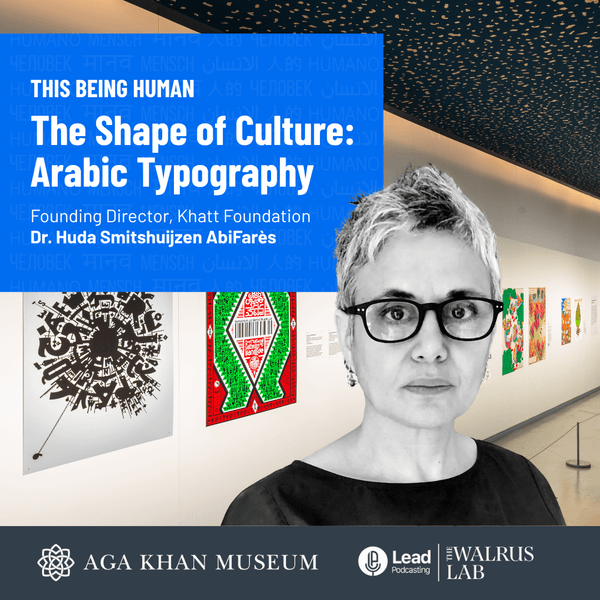
This Being Human - Dr. Huda Smitshuijzen AbiFarès
Dr. Huda Smitshuijzen AbiFarès is the Founding Director of the Khatt Foundation and Khatt Books publishers in Amsterdam. She works as an independent design curator, researcher, writer, designer, and publisher. She holds degrees in graphic design and design history from Leiden University (PhD, 2017), Yale University (MFA, 1990), and Rhode Island School of Design (BFA, 1987). Dr Smitshuijzen AbiFarès specialises in typographic design research and Arab design history. She is the author of several seminal books on the topic. She is editor in chief of Khatt Books’ Arabic Design Library series, and has authored two books in this series.
The Museum wishes to thank Nadir and Shabin Mohamed for their founding support of This Being Human.
Show Notes
When Dr. Huda Smitshuijzen AbiFarès moved from Beirut to study in the United States, she found herself doing something she’d never had to do before: explaining her own visual culture to people who’d never seen it. That challenge changed everything.
It sent her deep into the history of Arabic typography—how it grew from calligraphic tradition, was codified by ninth-century philologists in Baghdad, and is now being reimagined through algorithms and animation. And it gave her a lifelong mission: to show the world a side of SWANA creative culture that rarely makes it into the conversation.
In this episode, host Mai Habib sits down with Dr. Smitshuijzen AbiFarès to go behind the scenes of her exhibition Inner Structures, Outer Rhythms, explore what makes Arabic letterforms so uniquely expressive, and make the case that contemporary graphic design from the SWANA region is one of the most direct living continuations of Islamic artistic heritage.
Links & Resources
- This was just one example of Muslim art that sparked curiosity and a great conversation. There is so much more to see at the Aga Khan Museum. Support the Museum’s vision to impact lives and contribute to more inclusive and peaceful societies. Go to agakhanmuseum.org to plan your visit or make a donation.
- Visit the Inner Structures, Outer Rhythms exhibition page to plan your in-person visit—on until July 2026.
- Can’t make it in person? Explore the 3D virtual tour of Inner Structures, Outer Rhythms from anywhere in the world.
- Check out more episodes in full video.
Visit the Aga Khan Museum’s website or follow us on Facebook and Instagram.
If you enjoyed this episode and want to learn more, go to agakhanmuseum.org/thisbeinghuman
Mai Habib 0:20
Welcome to This Being Human, an Aga Khan Museum podcast about Muslim art, global cultures and how we’re all connected. My name is Mai Habib, your host. You know, every day we pass examples of typography. It’s on street signs, your coffee mug, even the alerts on your phone screen. And every one of those letter forms is doing something beyond just simple communication. In this episode, we’ll be exploring how letter forms become storytellers and why type really matters more than we even realize with Dr Huda Smitshuijzen AbiFarès. This past April, the Aga Khan Museum hosted Dr Smitshuijzen AbiFarès’ exhibition called inner structures, outer rhythms, a vibrant look at graphic design from Southwest Asia and North Africa and how it’s influencing culture around the world. Hi, Huda, welcome to This Being Human.
Dr. Huda Smitshuijzen AbiFarès 1:15
Hi, hi. Mai. Nice to meet you, and thank you for having me on this episode.
Mai Habib 1:20
Absolutely. We’re so excited to have you and so excited for this conversation. I mean, take us back a little bit. Tell us about your background and what first drew you to typography.
Dr. Huda Smitshuijzen AbiFarès 1:32
I think it’s my education, actually, that that kind of opened my eyes to the fact that typography is not something you know. When you see it every day, you take it for granted. You don’t think about it, and only when you start to study and look at it closer, you realize that this is a medium that has, you know, a long history in communicating human culture, human thought. It’s very important. Sort of the way letter forms look is not just esthetic. It’s also may a way of making information accessible, of giving a tone of voice to the to the text that you look at. So it’s a very, very complex study. And I studied, I mean, I’m originally from Beirut, and I studied in the US, and in my undergraduate the last, you know, the last project you have to do. You have to pick a subject to, kind of like a fine final, final year project, and being in another context, in another culture, it was really interesting for me to think, How can I kind of make my background and my culture, not, you know, explained or presented to a different audience that knows nothing about it. And so the fact that you have to explain something makes you look at it in a more critical way, in a more analytical way. And then I discovered that I actually find a lot of affinity with this, with this medium, and that’s the kind of typography, you know, became the thing that I really love to look at and study and work on.
Mai Habib 3:07
You touched on this a little bit. I mean, I wanted to find for our audience, what is typography, especially when we hear that in the context of fonts, right? And all the digital mediums that we use, versus calligraphy, versus hand lettering. These are things that we hear, and so we’d love to hear your definition of typography within this context, and then take us a bit further. You touched on it a little bit when you said your you know the juxtaposition of you coming from Beirut and then trying to find your footing and explain yourself and explain your heritage. What does typography mean in the context of heritage, what is the relationship there?
Dr. Huda Smitshuijzen AbiFarès 3:43
It all starts with writing. And writing is, of course, one of the first tools of communication that human civilizations reach at certain point. And so I think it writing is really important, and then giving shape to writing is also something that is always connected to the visual culture of the culture that produces it. So with Arabic, of course, it’s connected to calligraphy, in the sense that it started from calligraphy. And so calligraphy was used as a model to create printing types, cut off metal, and then eventually Mechanize, and then became digital, etc, you know, evolving every time with technology and with the possibilities of technology. So when we talk about, you know, in design, we have, you know, separate categorization. So Calligraphy is the beautiful way of writing. So it’s not just writing, but it’s writing beautifully. So it’s an it’s a kind of calligraphic art, actually, and even when you when later on, it was used for functional things. Eventually, you know, the term lettering came to express that, because then it was a matter of writing to express maybe an image or. Writing to communicate clearly. So it wasn’t so much about beauty, but about clarity. And then when, when it was mechanized and used for printing, then it became typography. And the idea of typography is really the repetition of the same forms to a certain extent, so creating a kind of visual system that is more pragmatic, if you want, than esthetic. But with digital, you know, technology all these three things, conversion and mix in different ways. And so today it’s you can you we use typography also for type settings. So, you know, just actually making a composition with letters, but calligraphers also make a composition with letters, but then they create an art form. So it’s kind of difficult to like. It’s not so clear cut the definitions. So when we talk about typography in general, we always referring to graphic design, or its use in graphic design.
Mai Habib 5:59
You know, you come from the the Arabic heritage perspective. For it, how has typography, sort of connected heritage, heritages to one another, especially in the Arabic world?
Dr. Huda Smitshuijzen AbiFarès 6:10
I don’t know if it can. I mean, I think that the heritage was always there was always a common ground. There was always a cultural exchange through the through the centuries in the in in the region and the Middle East. And so the script became one of the medium, but and so it was a natural connection, because people spoke a form of Arabic, a certain dialect, or had a different histories of different cultures coming in and out like you. Take example of Egypt that had many, many cultures from West and East, coming and mixing with the culture, plus the native culture. And eventually it became, you know, an Arab, an Arab country. So for Arab, from the Arab perspective, it’s always complex, because Arab countries are not the same. So what connects us is, I think ideologically, we say we’re Arabs, if you want. We speak a kind of Arabic. We definitely write a same language, and we have a majority Islamic religion. So that also connects people, although there are different sects and different variations of Muslim, Muslim communities within the Arab world. So there are connections, but there are also differences, and that makes, I think what, what the script does is, because it’s an abstract tool, it connects everybody, because we use it in communication, but how we use it, and what kind of visual and what kind of expectations we have, and what kind of perception we have of what is legible or readable Arabic differs from one country to another. I’m still learning. I’m still discovering things, and it’s interesting, because then research becomes easier with the technologies we have today. Also, people share more what they do. There’s not a lot of publications still, but there are some, and it’s interesting that sometimes also putting something out makes people stimulate the discussion and makes people interested in maybe researching more in depth about one topic, going deeper into some things, making corrections, discovering new stuff, so making additional information. So it’s a living you know, it’s a living thing, and in that sense, it’s like heritage and like culture. It’s living. It’s constantly changing, and it’s constantly evolving. I don’t know if we connect with it. Maybe to also other Islamic cultures, even though they don’t speak the language, they use the script, and they have done modifications on it to adapt it to their language. So I think in that sense, it’s also just a very pragmatic tool as a script that can be because it is phonetic, it can be adapted to other nations and other cultures.
Mai Habib 8:58
That’s interesting. And it is important to note that the Quran itself, which you’ve mentioned, Islam, is such a big connector of this region, the Southwest Asian middle, you know, the MENA region, Islam is really a connector. And the Quran is not translated. I mean, it’s translated so that, you know, English speakers or other native speakers, can can understand what’s being said, but the original text will always be Arabic and preserved in Arabic. So that’s really interesting, that that in itself, that that the the crossover of culture and religion is also what’s taken the typography and the Arabic language and those letters, and, like you said, been appropriated to sort of the phonetic maybe not the actual definition of the same words, but just the phonetic meaning of the letters, because they’re so familiar with the Quran as an Arabic medium.
Dr. Huda Smitshuijzen AbiFarès 9:48
Yeah, also, I think it’s, I mean, the language is also a language that you know originated from Bedouin Arabia, and then it had to be learned by all. These other cultures. So it’s also a language that was really later, you know, it was oral language that was that philologists in ninth century Arab world like Baghdad actually sat down and made rules for it and codified it, and we learned that language. So in a way, it’s like it’s not and they’ve used the Quran as also as a way to verify and to codify the Arabic language. So this language connects us because it’s formal language that we learn when we speak. We might speak different dialects that have borrowed words from ancient cultures where we come from, from mix of Turkish, Greek, Roman, whatever. You know, all these cultures that have gone through. So it’s interesting that we have two also, every Arab country has two languages in some ways, plus, if they want to add more, depending on their colonial history.
Mai Habib 10:57
I was just going to mention that depending on that, there is a lot of mixing that’s absolutely correct, especially in the northern Africa area, there’s a lot of mixed languages there. You know, you said something that I really want to pick up on, which is, you know, you’re really a subject matter expert in Arabic typography and sort of the history there. And you said you’re still learning, you know, there’s still, you know, you’re still onboarding information. As you dig in deeper, bring us along that journey. What do you feel makes the Arabic alphabet so special? Because it really is the alphabet right like when we’re thinking of typography, we’re really visualizing those letters. And you know, for many of our viewers and listeners, they’ll probably already know that Arabic is actually written from right to left, as opposed to most other languages that are written left to right. So of course, there’s that obvious. But what is so special about those letters you found?
Dr. Huda Smitshuijzen AbiFarès 11:51
What I find fascinating, for example, about Arabic because of its wide tradition of especially the older scripts that were not so codified and did not follow rules. There was a lot of experimentation and in interpreting how the letters should look like. And what is fascinating is that for for people that know the script and know the language well, they can read all these scripts that if you put the letters next to each other from the different they don’t look alike, and then we still guess what they are. So I find that really very unique to Arabic. I don’t know if other, if there are other scripts that have that, I’m not sure. But certainly in Arabic, we have that. And sometimes I find, you know, I never thought about it until when I was shown, you know, dealing with Europeans and trying to work with European designers and make them collaborate with Arab designers on developing new typefaces and curating this process. And we had to explain that, yeah, this is the same letter, and that’s that’s when it hits you that, wow, I can actually read it, but I can’t explain why it’s the same letter. So it’s interesting in that sense, it’s also an interesting script, because it can be very compact. So you have a basic letters, letter forms, and you keep the vowels out, and you can add them when it’s absolutely necessary, when you think it’s necessary when. So it has kind of like different layers of developings, of representing sound and making no meaning clearer. So it’s also kind of, is a script that you know can be shorthand in the sense, like, if you know how to read the language. I don’t need to give you all these extra details, because you would know.
Mai Habib 13:36
I do really want, want you to be able to tell our listeners and viewers about the exhibition. So take us behind the scenes. It’s called inner structures, outer rhythms, which, in and of itself, just such deep meaning in the in just the title itself so poetic and beautiful. Where did this idea come from, and what was it like bringing that to life?
Dr. Huda Smitshuijzen AbiFarès 13:59
To start with, the simple story is that it was kind of, I was invited to do this exhibition to an American audience, and I thought, okay, if I’m going to do an exhibition on design, typography, Arabic typography, to or to an to a foreign audience, what do I want to show? And so it was, it was really important to for me to show that they are, you know what we were talking about before, the connections between the different regions, different nationalities within this region, the different languages, the different backgrounds, the different visual Heritage. But also not to be like, not to only show what people expect, which is very traditional manuscript. I did not want to do that, even though I know that these traditional manuscripts and this traditional Calligraphy is an inspiration for contemporary designers. They take it, but they do something. You with it. So I wanted to find these kind of works that address these things. And of course, you know, then you start the mix of different topics. And so, you know, we always think of this region, at least, the only part in the West that they see of our region is wars and conflicts, which are there? Of course, there’s more to it, and I wanted to show the other side, the side that is more less known, which is the poet, the poetry, the love for music, the visual. You know, even when you are making political protests, you’re going to use poetry and rhyming to do your statements. You’re going to look at the script and try to experiment with it, and look at it as a visual plastic form that you can create images with, that you can create textures, that you can create moods, and rather than just communication, so and it’s also the idea that you have in typography and then the letter form itself. You have a structure, which we were talking about, the structure that kind of defines what a letter is, even if it looks very different every time. There is some traits that define it a certain structure. But there’s also a rhythm of letters being together, interacting, and then how they create lines. And so so it had multiple layers. And when the when the exhibition was finished, it was we produced a catalog, and then I thought it would be really a pity to not have it travel. And so it traveled to a couple of places, to Germany, to the Design Museum in Hamburg, and to VCU Qatar, the Virginia Commonwealth University in Qatar, in know how. And then to finally, the final resting place, the Museum in Toronto. So this is a bit the story of it. I think that you know the more that every time the exhibition went to a new location, it adapted to the to the context a little bit. And, of course, you emphasize something different. So in Qatar, you don’t need to, you know, explain so much about the culture, but you emphasize the esthetics and the experimentation. In Germany, you have to explain more detail about, you know, the connection to the culture in the Aga Khan Museum. I think was interesting to make relationship, you know, make the this relationship between the heritage and manuscripts and the older artifacts in connection to the pieces in the exhibition. So you had pieces that, you know, were clearly inspired my manuscript culture, even, like, discussed it in the work, you had pieces that really looked at, you know, the esthetics of carpet and this idea of, like, over ornamentation. And you had, you know, other works that worked with, you know, Islamic architecture and its kind of geometry and simplicity and kind of building letters based on that. So there were all sorts of things that you could, you know, use, actually, the museum collection and conversation with with the so it was really perfect. Actually, it’s a found a perfect home.
Mai Habib 18:11
You mentioned how you had to kind of adapt it to every area right between Germany and then in Qatar. You, you know, you don’t have to explain the the lettering so much, but you contextualize in other ways. That’s how you adapted it to different places. But how do you feel like these different places and audiences reacted to the work itself? Because typography, like we talked about, it, gives people different feelings, right? People kind of interact with it differently. What was the feedback? What were the interactions and engagements like in these different places, very west versus east?
Dr. Huda Smitshuijzen AbiFarès 18:42
Right. In the in the university, it was really the students were very fascinated by all the experiments, and they were just excited to see some of their design heroes work in real life. So let’s put it this way. So that was nice, because the designers, you know, the designers are very in the exhibition are very known and very representative of the culture. I mean, they were not the only known people. You know, you had to limit what you can show, but they are quite representative, and they are quite known. So they were very happy to see that, whereas in Germany, the audience is very different because it was in a design museum and also in the Islamic art collection. But their Islamic art collection is relatively small, and it tend, it tends to be, you know, the traditional objects. And so for them, it was interesting because it opened up a conversation with the local, let’s say, Islamic Middle Eastern community within Hamburg that normally doesn’t come so much to their museum. And it also created the kind of conversation and a kind of like understanding of, oh, it can also be modern, you know, because in their mind. And, you know, it’s they’ve never seen really designed from from that part of the world. So it was complete discovery. And the reaction was in many ways, like people really loved it, and they had really good response. And we eventually had the collaboration with the University in Hamburg for conference on the different topics. And some of the designers were there, and some, like, more scholars came and talked about, you know, their research on the scripts, different scripts. So it was really a bit, yeah, it was really very, very nice collaboration. And it opened up a complete different conversation and networks within within Germany, but also, I think, gave, you know, the project, a kind of academic side that was not originally part of it. So I don’t, I mean, and I don’t know in the Aga Khan what the reactions have been, but a few people that I know that have visited really liked it. They were just saying, Oh, I wish it was bigger. They want more.
Mai Habib 21:10
That’s but that’s incredible. I’m sure for you, that feels incredible that your work in bringing this part of a positive, like you said, a positive light to this part of the world and this history, this not known, part of the poetic must feel so good. And you said something that in Germany, it’s it ignited new conversations, right, that weren’t happening. I mean, is that kind of your ultimate goal as the curator here?
Dr. Huda Smitshuijzen AbiFarès 21:36
I think yes, of course. I think I wanted to bring a different conversation than just what, what people, what people always talk about, you know, again, to we’re always, you know, like the whole area is, is the way it’s talked about is very reductive. It’s conflicts. Is one religion, one people, blah, blah, blah, but it we know people that come from there. We know that’s not true also. It also makes it sound like culture is in vacuum. I mean, culture is always also in the region. Is very diverse. It’s always been in conversation with, with, with the West and Europe, and Europe and the Mediterranean is a very lively history where people come from, have always been interacting, you know. So that story nobody, nobody knows and or have conveniently forgotten. Let’s put it this way, so they focus on the negative things. Of course, there is also negative history of, you know, of colonialism, of invasions, of data that existed as well, but there’s also a good side to it, and we can, you know, choose which side we want to look at. And so I, for me, it’s important, especially nowadays, it’s important to bring this conversation and say, you know, we have to look at things that we have in common, and look at things that are different. When we are different, look at those differences as interesting and not as scary. And so taking it, you know, taking a work that is that doesn’t say that is using the Arabic script doesn’t necessarily mean it’s scary, phonetic, Islamic, whatever label they put on us. It’s also just what it is. It’s posters for culture. Culture happen. We have we have exhibitions, we have music, we have art institutions. We have a very dynamic culture, secular culture that happens that is lively and well and from this time and age. And I think that that message came across in a nice way.
Mai Habib 23:49
And I think people who travel to the region can appreciate that it is not a homogenous space, right, like you’ve already brought up so many of the nuances. And the exhibition itself focuses on the SWANA region, right? So Southwest Asia, and really we’re talking about like Iran in this context. And then, you know, the North Africa, Middle East, the MENA region altogether referenced the SWANA. What other facts do you want to highlight about this region? Because I think you’re bringing up so many important dynamics that maybe you’re right. Are not appreciated if you only sort of are absorbing what’s being pushed on you or said to you, you might not have that engaged perspective and would just love to know any other facts about this region that are important to keep in mind.
Dr. Huda Smitshuijzen AbiFarès 24:36
Well, I mean, I think what’s important to keep in mind is that this region has a lot of very young people. So it’s a young they’re young cultures in general, and they’re very well educated in general. And there’s a lot of passion about, you know, reclaiming their voice and their identity, but not being dissociated from the rest of the world either. So sometimes it’s also the preconceived idea that, you know, if countries have political frictions, that everybody in these countries hates the other cultures, which is not true most, most governments in the Middle East hardly represented are their people. So it’s like, it doesn’t matter what the politicians say people feel might, might feel very differently.
Mai Habib 25:23
You know, I’m sure a lot of listeners are going to hear this episode Hoda, and want to run to the Aga Khan Museum to see the exhibition. What do you what do you want them to walk away with? If Is it a is it a feeling? What is it a conversation? What do you want visitors to this exhibition to really walk away with?
Dr. Huda Smitshuijzen AbiFarès 25:43
I would love if people just walk in and just let themselves experience without preconceived ideas, without trying to make sense, because sometimes, yeah, art should touch you. You know, they should be touched by what they see. They should not walk away indoctrinated into this or that. I mean, for me, it’s presenting something new, and then seeing the feedback of how people react to it is all I like to see. It’s more like an experiment. Graphic design is kind of a natural continuation of Islamic art and design. It’s really what it is. It’s the contemporary form of that. And, you know, they can see these relations between old artifacts and the inspirations and how and a designer today, working today, finds source of inspiration in these pieces and then writes, you know, uses them differently and produces different work with that. So I think it’s also, I would like that message to be clear that that design is a kind of design in the SWANA region is a continuation of the of the Islamic art heritage.
Mai Habib 26:57
And you know, this, this exhibition may have started the conversation, but it’s certainly not the end of the conversation. And you know, future generations are going to keep experiencing typography in different ways, and you know, helping them connect to the language, the literal language, but then also the culture, which is exactly what your exhibit did, right? It reframed, or tried to reframe, a culture that maybe has a lot of preconceived notions around it, and it’s not even one culture, right? Like this dynamic, this group, this plethora of cultures that happen to share the same letter basis, I’m not even going to say the same language, the same letter basis that make up sort of their dialects. What do you hope future generations? Or what does that engagement with typography specifically look like for you in the future to learn their own language and culture. You know, Arab language and culture, Islamic just that interface between us as a culture and typography.
Dr. Huda Smitshuijzen AbiFarès 27:55
It’s hard to tell what the future is going to be like, but I don’t I think what I see from the past 20 years, I can imagine that it would continue where the script remains a central tool or a central element that’s used in art and design in the region. But then, of course, it’s transformed by the different technologies. So nowadays you see people creating typography by algorithms. So they write script, and then they have these wild animations with the script. So I don’t know if you know, if we will see more of that. I’ve seen, you know, works in that that start from a digital animation environment and goes to print. So there’s also this mix of people working, you know, generating, almost by by computer, a design with the script, and then printing it in, like very traditional printing techniques. And so they’ve so this kind of mix and matches from today. I don’t know what the future will be like, but I imagine that, you know the script will always be, will always be central to our visual language.
Mai Habib 29:07
Any other final thoughts, whether you want to share?
Dr. Huda Smitshuijzen AbiFarès 29:08
Thank you for having me. I think I really enjoyed the conversation and meeting you absolutely. And I just encourage anybody who’s in Toronto and has the time to just swing by and come to the museum, not just for this exhibition, but the museum itself is also has a beautiful collection of works, and it’s a beautiful museum to visit.
Mai Habib 29:31
Absolutely, the whole museum itself will move you. And then, of course, your exhibition, Huda. Thank you so much for joining us today. The exhibition will be on until July 14, 2026. So if anyone wants to go, now is your time. There’s also a 3D tour for people to view the exhibition virtually, now and even after it closes if you miss it. To take that online tour, visit agakhanmuseum.org/what’s on. Whether you see the exhibition live or online, let Huda know how you feel about it. She wants to hear how the Toronto audience is reacting.
Dr. Huda Smitshuijzen AbiFarès 30:10
Absolutely. I would love that. Thank you very much. Thank you.
Mai Habib 30:15
This Being Human is brought to you by the Aga Khan Museum, a place where centuries of art inspire new conversations every day, as you heard with Huda now. This podcast is produced by Jules Ownby and edited by Zia Khalid. Amanda Cupido is our executive producer. I’m Mai Habib. If you enjoyed this episode of This Being Human, be sure to hit that follow button to catch the next episode available on YouTube and wherever you get your podcasts.