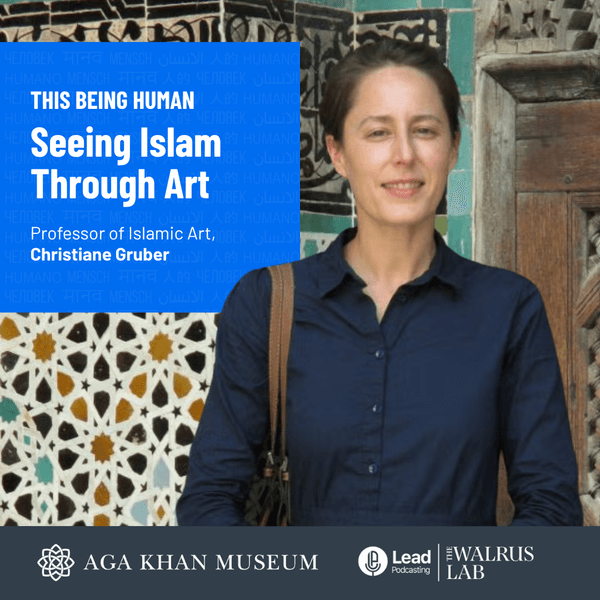
This Being Human - Christiane Gruber
Christiane Gruber is the Mehmet Ağa-Oğlu Collegiate Professor of Islamic Art History in the History of Art Department at the University of Michigan, and founding director of Khamseen: Islamic Art History Online, a free digital platform for teaching Islamic art and visual culture. Her research spans medieval to contemporary Islamic art, with a focus on figural representation, depictions of the Prophet Muhammad, and book arts. She is the author of several books, including The Praiseworthy One: The Prophet Muhammad in Islamic Texts and Images (Indiana University Press, 2019).
The Museum wishes to thank Nadir and Shabin Mohamed for their founding support of This Being Human.
Show Notes
What ties an 8th-century mosaic in the Dome of the Rock to a contemporary abstract carpet? For Islamic art historian Christiane Gruber, that question has driven three decades of research—pushing her away from the idea of a single “Islamic art” and toward a field defined by plurality and contradiction.
In this episode of This Being Human, Gruber joins host Mai Habib to read political meaning into sacred ornament, and to dismantle a persistent myth: that the Prophet Muhammad has never been depicted in Islamic art history. She traces how these depictions evolved from detailed faces to veiled figures wrapped in flame, and closes on her newest research interest—eco-Islamic art —and why stewardship and sacred water feel more urgent now than ever.
Links & Resources
- This was just one example of Muslim art and culture that sparked curiosity and a great conversation. There is so much more to see at the Aga Khan Museum. Support the Museum’s vision to impact lives and contribute to more inclusive and peaceful societies. Go to agakhanmuseum.org to plan your visit or make a donation.
- Explore Khamseen: Islamic Art History Online, Christiane Gruber’s free digital platform for teaching Islamic art.
- Learn more about Christiane Gruber and her research at the University of Michigan.
- Read more in Anna Gade’s Muslim Environmentalisms: Religious and Social Foundations, referenced in the episode’s discussion of eco-Islamic art.
Visit the Aga Khan Museum’s website or follow us on Facebook and Instagram.
If you enjoyed this episode and want to learn more, go to agakhanmuseum.org/thisbeinghuman.
Mai Habib [00:00:21] What can Islamic art show us that headlines about the Muslim world often leave out? Today we’re exploring that question with Christian Gruber, professor of Islamic art at the University of Michigan and founding director of Khamseen, Islamic Art History Online. I’m Mai Habib and welcome to this Being Human, an Aga Khan Museum podcast about art, global cultures, and how we’re all connected. Professor Gruber, hello. I’m so excited for this conversation. Thanks for joining us.
Christiane Gruber [00:00:50] Thank you so much, Mai, for inviting me. I’m thrilled to be here.
Mai Habib [00:00:55] So a lecture that you had called Islam Through Art, in it you pose this question to your audience of, what is the first thing that comes to mind when you think of Islamic art? And I’d like to hear your table setting for this conversation, Professor Gruber, what do you think when you think of Islam?
Christiane Gruber [00:01:16] Oh, thank you for turning the tables on me. It’s much easier to put the question to other people and sit back passively, waiting for responses. You’re welcome. In the past, I might have answered the same way as my students would or as general audiences would. And I’ve asked that question over the course of two decades. And the answers that always fly in either through the chat module or through hands that are raised up. Range from geometry to calligraphy to Persian vignetures, carpets. You’ll hear the smattering of iconoclasm or aniconism, lack of figural images. You’ll also hear colors, you know, you’ll hear general audiences say blue or gold, so Leningrad has a kind of a color palette that it evokes in certain people’s minds. And so that’s kind of the landscape that I’ve seen over the years. And I think that could have been maybe the landscape that drew me when I was just a junior in high school. But over time and with professional deformation or formation maybe, you come to expect something different. And now that I have been studying Islamic art for over three decades, I have come to inspect the unexpected. All this to say that the more I discover As I keep doing fieldwork and research and writing my way through quandaries, the more I realize that what I think I know might not be accurate or I need to revise a presupposition or I needs to expand my corpus or some finding sort of upends a hypothesis. And that’s not only what I like about Islamic art, but that’s what I really like about the humanities in general. It really forces an unlearning and a relearning that never ever ceases.
Mai Habib [00:03:07] What has Islamic art taught you about Islam itself?
Christiane Gruber [00:03:12] I think it’s taught me a lot in the sense that Islamic art is an expression that is creative and non-linguistic, and it can take a variety of different iterations across places and times. And so if you look at a creative expression, a visual art or a material form, let’s say That would look very different from say a carpet made out of pins by a modern artist like Aisha Khaled whom you just interviewed.
Mai Habib [00:03:51] That’s right. She’s been on the podcast.
Christiane Gruber [00:03:53] So, the question always has been what ties an 8th century mosaic from the Dome of the Rock with a big abstract carpet from today. There have been a number of different exercises, you know, in scholarship trying to explain an underlying ethos or a drive towards certain creative expressions. But what I’ve learned is that no matter how much we want to sort of impose a analytic or cohesive picture. That a lot of these visual arts and expressions that are really creative can’t actually be subsumed under a single label. And so what it’s taught me to do is actually think outside of the singular and embrace the plural. And so just like other scholars who argue that we shouldn’t say Islam, but Islam’s in the plural Interesting. Yeah, Islam’s, you know, or a kind of an Islamic complex that spans the world where really the prime is placed on diversity and richness and even incommensurate materials, right, things that kind of defy expectations. I think that’s what I’ve learned is that in seeking sort of an answer, a simple answer, we will hit our heads against the wall and it’s better to expect the capacious and contradictory.
Mai Habib [00:05:16] So I grew up, full disclosure, I grew up, my family’s Egyptian, we immigrated to Canada. I’m in a Muslim Sunni household. And I always, I didn’t realize when I was young, but I realized it as I got older. And I’m interested in your view of the conflation of Islam and culture. And I find it really interesting that you say Islam, like this variation, because Islam is not this monolithic, homogenous population. There are people from around the world who have so many different cultural infusions that also kind of inform the way they practice Islam or what that looks like in true manifestation. And I’m wondering, when you’re looking at the Islamic art history, Where are the lines of the true Islamic history and then the cultural infusion into that? You talked about where it is in Syria versus Persia. What does that look like?
Christiane Gruber [00:06:13] The first thing I would say is, I would stay clear of the expressions of true Islam, because just like any other religious culture, it has a matrix of development over time. And so we’re true would also be synonymous in some cases with the notion of orthodoxy. And orthodoxy, what is true, is really nothing but a position, an argument that comes about through moments of consensus. Right? And so once you have an orthodox or a normative position, that’s when you’re then veering into schismatic positions or even heresies. And so if we set aside this notion of true Islam, which is… One of the big pitfalls, I actually think, than the notion that there’s only one true Islam, because there have always been variations and developments and mooring points. Once we get rid of that, we realize that the history of Islam is also a cultural history. It’s also a religious history. It’s a political history. What might have started off as a political schism actually turns into a religious schism. And here we’re talking, you said you’re from a Sunni family. Sunnism and Shiism was really about a political issue. That’s to have authority over the early Muslim community, right? Is it the companions, you know, or is it the family? And then that actually gets articulated in meta terms, symbolic terms, and then it becomes a religious schism. And so religion, culture, and politics are very difficult to untangle. And those are the imbrications I think that we want to not sweep under a rug, but actually kind of pinpoint and unravel. Little by little. Those are more interesting and they’re more accurate from a historical perspective.
Mai Habib [00:08:04] How do you see the untangling or the tangle between the culture and Islam as a religion, and maybe even the politics, how do you feel that playing out in the art?
Christiane Gruber [00:08:16] Yeah, no, you see it quite a bit. I mentioned the Dome of the Rock, for example. When you walk into the Dorm of the rock, you’ll face on the interior, these really lavish, beautiful mosaics that represent a vining plants that are encrusted with jewels. You’ll see also these wonderful kinds of crowns that have little wings. So you might think, oh, this is quite lovely. It’s iconic, it’s geometric. You have gems, you have vegetal patterns. And therefore maybe it doesn’t have much meaning, right? Except for maybe the ornamental. But within that lexicon of the visual, you will have political and religious messages. And so, for example, scholars who have studied the mosaics have said that one of the possible meanings of those hanging crowns that have wings is that they represent the crowns of the Sasanians, that is the Persian Empire that was decimated by the early victories were crushed at the battle of Tezifon. So those are actually kind of spolia and they’re a super sessionary discourse about who got to win. And so something as banal maybe as just a crown is really about showing that you are primus inter pares, that you’re the leader of the leaders and you’ve been able to conquer lands and loot treasuries. And take the crowns of others. And so it’s important, I think, when you look at the visual art to go into the depth of the possibilities of the semantic field in which you’re operating, which transcends linguistic messaging. Because the messaging is not tethered necessarily to language. It’s tether to this other ambit of icons or… Messages that are permeating your time.
Mai Habib [00:10:13] As part of your studies, you talk a lot about the depictions of the Prophet Muhammad, peace be upon him, in Islamic art, and there really is this sort of widespread assumption, and honestly, even having grown up in a Muslim family, we were told there are no depictions of the prophet Muhammad. That’s like one thing that we always come back to, but your studies have actually shown that that’s not true. There have been depictions of the Prophet Muhammad. Can you tell us what you have found and how he has been depicted through Islamic art?
Christiane Gruber [00:10:50] Yeah, sure. I mean, this has become a modern truism that there are no depictions of the Prophet Muhammad in Islam. And it’s been part of this growing emphasis to find a point of differentiation between Judeo-Christianity and Islam. So a differentiating factor or another rising factor. We like very easy polarities, you know, and categories and taxonomies that help us classify. Religions, peoples, cultures, you know, and so it’s very easy to latch onto that. You know, Islam is different because it doesn’t have figural images, it is a very easy way of memorizing things, but the more you look at it, the more it starts to break down, and it breaks down pretty quickly. And so images of the Prophet Muhammad in Islamic traditions exist. They’re mostly in manuscripts, so books that were made by hand that include illustrations, so paintings. And those manuscripts that include images of Muhammad tend to date between 1300 until the 1900s, including printed volumes. And so the reason we might not see them or might not know about them, actually, it makes a lot of sense that you wouldn’t have heard, really, about it because these were in small elite whoops that were made oftentimes for princes and kings that They, you know, before really the digital turn were not readily accessible or visible because they were in, say, national libraries or private collections or in museums. But now it’s much more easy to access that data because so many of these items actually have been digitized and are placed online. So it’s not difficult to find all of this material now. And so when you look at the corpus, you realize that there was, especially in Persian lands, much more so than in Arab lands, that in Persian land there was a rich tradition of representing the prophet for devotional reasons, for historical narrations, for also promoting certain kinds of positions, be they political or religious. And there’s also a trajectory of development of representing a prophet. So, in the earliest images, you see his facial features, but eventually by the 16th century, you see the development of a white facial veil that covers his face and then a flaming halo to convey the notion that he emerged from the divine flux of the divine realm of God that he carries the light of God.
Mai Habib [00:13:32] And that change and how detailed his face was or the veil or, you know, the additional lighting for divinity, what is the connection there with the spirituality and again, like really looking at it from an Islamic art history view, what does that transgression
Christiane Gruber [00:13:52] I think that some of the answers for that trajectory, where you see facial features, then a facial veil, then a flaming halo, and then the disappearance of the body itself into, say, a calligraphy with the name Muhammad, it’s a very interesting process of abstracting the human body. And when you think about modernism, that’s what modernism is. It’s abstractionism. So there’s an interesting process of becoming more abstract. But if you look within the Emig, the indigenous Islamic tradition, and you try to understand why these motifs appear, a good place to look for them is in poetry. A lot of these images of Muhammad are in Persian texts and quite a few of them are poetic, and they also include poetic descriptions of the Prophet Muhammad. And oftentimes, he’s described as too beautiful to behold. A blazing mystery as something that’s beyond comprehension and so brilliant that you can’t look at directly. And so when you think about the facial veil and the blazing halo, it’s much more than an avoidance of figural imagery. It’s actually about conveying the more than human nature of the Prophet Muhammad that’s expressed poetically, and in this case the oasis is also in visual form. And so the facial veil is considered to be this veil of the firmament that separates you and the prophet because, you know, God forbid that you should be able to access that realm that’s inaccessible to you. Or if you were to look upon him, the newer Mohammed or the lighter Mohammed might actually kind of burn you because he’s so resplendent. And that actually, that pattern you can see in the pattern of the prophet Moses. Who after having spoken to God as a blazing or fiery bush actually covered his face in order to not to burn up his followers. Scholars refer to that pattern as the mosaic pattern, meaning the pattern of Moses. And some of the narrations that are linked to the Prophet Muhammad follow that Moses paradigm. And this is one of them.
Mai Habib [00:16:14] What’s interesting is, it actually speaks to this concept in Islam, which is that we are souls, right? Like this is a physical body that I am just almost like borrowing from God for the time that I’m here on the earth, but who I really am, who Mai Habib really is, is a soul and that is who is accountable. And it is in that soul that we understand that we can see this other place, right? These other sort of the other side, the divinity. Because our human manifestation just— you cannot interact with that realm.
Christiane Gruber [00:16:47] Yeah, and here you’re getting to, I think, a really interesting other proposition in Islamic thought and philosophy, and the proposition is that the exoteric or the external is different from the esoteric, or the internal. And that’s known as the batin, the esoteric versus the zahid, or visible, right? And so a physical body is what’s visible. It’s the dhāhir, what’s visible to you or external, but we have to really focus on the inner core of the human being, the bātn, the rūḥ or the spirit, and the maqnah, the meaning behind what is perceptible. And what I find particularly interesting, but also challenging, and I’m sure it was much more challenging for the artists, is how do you convey an interior… Predisposition or ethos or character by using your language, which is external representation or figural form. That’s really challenging. And you see Christian artists struggling with that too, with Jesus Christ, because he’s considered to be a trans substance, right? A meeting point between humanity and infinity. Mohammed? No, he’s fully human, but he’s been touched by a divine flux. And so you see those negotiations by artists, not just in Christianity and Islam, but in other places where the artists are trying to represent something that manifests in a visual or even human form, but there’s more to it. So the question is, with the language of form, how do you get to the more than human characteristic of the represented entity? That’s a big challenge. And so one of the things I’ve thought about is that when does a picture stop being a picture and become picturation because there’s a difference between a picture and a picturation.
Mai Habib [00:18:54] Tell us about the difference between that. Tell our audience about the differences.
Christiane Gruber [00:18:57] A picture is when you’re representing something in manifested form. Whereas a picture evasion is when you wanna represent something in a more conceptual or notional form. So, and when you are representing the prophet, you can’t represent him as if he’s sitting in front of you and you’re doing, you’re creating an image from a live subject. What you’re do is re-presenting, so you’re presenting once again the notion or the concept. Of the Prophet Muhammad and not just as the human or the body but as the memory and the thinking about the Prophet has evolved over time into what is considered a corpus propheticus right or prophetic body that there’s all of these characteristics not just in physical form but in conceptual form. And so that’s the difference between a picture and a picturation. A picturation is a conceptual picture. As opposed to a mimetic or life image.
Mai Habib [00:20:00] Where is the dichotomy? So in Islam, the Prophet Muhammad, peace be upon him, is referred to as just the strongest, greatest man that ever existed, right? Like he is, there’s a sunnah, which is you are trying to live the life and follow in the footsteps of the Prophet because he was, again, human, not God, but he really was like the closest to perfect that you can get as a human. And now you’re saying this picturation, so people are trying to take this image in the way he’s described. And turn that into something that you can see and interact with. Is that where the veiling and the lights and is that where it’s coming from, this Noor?
Christiane Gruber [00:20:42] I think to a certain extent, absolutely. And so, when you’re talking about the Sunnah, for example, we think of the Sunna as the Quran and the Hadith, so the revelations to Muhammad, but also his deeds and his acts. And there’s other texts in there that are interesting for the images. And those are the early texts that are related to the Seerah, so the life of the Prophet, but also some other texts that are known as the Dalail al-Nubuwa. So, the proofs of his prophecy and the Shamail and Nebi, which are the characteristics of the Prophet. And those two texts, the Dalail and the shamail, describe all the proof of his prophesy and also his physical and characterial attributes in descriptive terms. One idea is that the Prophet Muhammad smelled beautiful, right? Maybe he had aromatic aroma that he used in mosque or… Rose water. And so sometimes you’ll see images of the prophet surrounded by roses or even depicted like a pink rose. And there is a doctrine that’s known as the Rose of the Prophet that develops in Sufi, Sunni Sufi cultures in the later Ottoman period. And so you will see depictions of the profit as a pink rows.
Mai Habib [00:22:00] You also founded Khamseen, which is an Islamic art history online. And it’s a really interesting website. Actually, I was playing around and downloading things as I went. So how was, how was this concept of Khamseen born? And was there something, was there a gap you were trying to fill? Was there a bridge you’re trying to build there?
Christiane Gruber [00:22:19] It was born in COVID, so it’s a COVID baby.
Mai Habib [00:22:23] I have a few of those myself, yes.
Christiane Gruber [00:22:25] We don’t know how it is, some of them laugh, some of them come and go. Yeah. But you know, when COVID broke out, all of us had to then go pivot to remote teaching, then we’re all in zoom. And then I realized it would be nice to, since we were all teaching on zoom, it would be for students to hear my colleagues talk about their fields of expertise. You know, the more approaches and the more. Fields of specialization, the better. And then I realized we could actually create microtalks among us and then share them with each other. And so again, here again, I’m working with my colleagues and then all of us discovered it’s actually really nice, even when you’re teaching in person to maybe lecture for 15 or 30 minutes and then say, and now let’s do this little lecture that’s recorded by the expert in such and such a topic. So you pivot and you actually cede your voice to your colleague. And I think that’s extremely important for general audiences and students to see you yield to expertise, a really important move. And then we have worksheets and so the students can fill worksheats. And the nice thing about these micro lectures that define topics or five minutes for a term is that the students go back to them and play them online. If you’re a lifelong learner or just an internet user. You actually have virtual access to even items in storage in museums. And for me, this free and open access possibility, especially in collaboration with other institutions that allow us to shoot these videos inside storage, it’s the ultimate tool for teaching with no barriers. I mean, the only barrier is access to the internet, right? But besides that- But it’s free, otherwise.
Mai Habib [00:24:17] People are going on excellent.
Christiane Gruber [00:24:18] Yeah, yeah. For me, it’s a sapping and undermining of the ivory tower. And the goal is just to make, you know, educational materials just completely available in a free and open fashion. And now, after about five years, we’ve had about half a million views and we’ll keep growing as far as I can tell. Those are not students. Half a million people. You know, those are people using the Internet trying to learn something.
Mai Habib [00:24:47] So on Khamseen, obviously, you explore different themes, different histories, and all of it is on there. And I’m interested in your view on eco-Islamic art. Is it a new concept? Has it always been there? We just didn’t talk about it. Just tell me about this eco-islamic art.
Christiane Gruber [00:25:07] Yeah, I think the practice has always been there to create expressions that are creative but based in or related to nature. So the practice of ecologically oriented art has always been there in Islam. To give you just one example, the Kaaba, right? I mean, that is the building by excellence of Islam. It’s the holy of holies. It’s the direction of the kibble. It is the temple of God on earth, the baytullah, around which the believers circumambulate, perform the hajj. So the Ka’bah is the sacred site for Muslims. But it also is the quintessential reliquary of a black stone. One of its corners has al-Hajj al-Aswad, a blackstone. Next to it is a Zamzam well.
Mai Habib [00:26:01] The never-ending well of Zem Zem. That’s right, yeah.
Christiane Gruber [00:26:03] And so when you think about the Kaaba or the Haram, right, the sacred precinct of Mecca, it is inviolable territory, which is known as the Harum or a Himma, right? A commons that’s protected. You can’t kill anything, not humans, not plants, not animals, this idea of the Harim. And at its center is a rock and water. And we tend to forget this nowadays. But the beating heart of sacrality for Islam involves a rock and water. But there’s been now in scholarship something known as the green turn or ecological turn, along with the Anthropocene and climate change, you know, climate disaster. There’s a lot of scholarship now in the post humanities and animal studies, something known as the blue humanities, so focusing on oceans and waters. Green turn towards nature, you have the blue turn towards water, and most of that has been by scholars working in Europe and the Americas. And so it’s not that you want to fit the Islamic part into what’s already been written about, but you want to ask within the Islamic tradition, what are the ecological creative expressions and sort of engagements that you find and what does that suggest? And so that has been my next set of projects and that’s my next book, where I look at, you know, depots or granaries, you know how do you store foodstuffs? How do you engage with pebbles and rocks and mountains about winged entities of the wind? So how do you engage with birds? I’m writing a whole chapter now on avian architecture. So bird architecture. So the post-human, like the non-human non-anthropocentric, How do you have a more so zoo centric? View of the world, or how can you imbricate all of the creatures of the world, plants, humans, animals, and then what are the created activities that emerge out of that, from birdhouses to depots to, you know, aquatic landscapes. So that’s the next book for me.
Mai Habib [00:28:13] Why is it so important, why is it’s so important to bring these things to light, particularly now this, you know, the intersection of Islamic art and ecology or that, you know, ecosystem? Why is this so important?
Christiane Gruber [00:28:28] So it’s always been important, but, you know, there’s now a real focus on what’s known as the Green Dean or the Green Faith. And so scholars, including my colleague Anna Gade, who’s written a whole book on Muslim environmentalisms. And now that you have how to green your Hajj manuals, there has been an effort to make a point that green theory or environmentalism, or at least an ecologically oriented ethics, is actually baked into the Islamic tradition. So that work has been done. So you have green Muslims who show that, you know, ecologically ethical approaches to nature and the environment are in the sunnah, they’re in the corpus. And the reason it’s become increasingly important is because when you talk about climate change… Front lines of climate change are in areas that many of us have navigated. So for example, if you’ve gone to Morocco, you will see the dying palm oases. And I can tell you, and I’ve done those drives through the oases, it is heartbreaking to drive through kilometers and kilometers of dried and dead palm trees. Yeah it will break your heart. For the North Africa, Mideast, Middle East or South West Asia, the Swana, right? This region is at the front lines of climate change and you see things changing at such a rapid pace that at some point you have to try to do something or say something or find other solutions or try to explicate why it is that You have to proceed with. Caution and with respect. You know when you’re performing the faith or you’re engaging in faith-based practices, it is often the case that you’re doing it in and with nature.
Mai Habib [00:30:32] And God entrusts us, right? Like there is a deep concept of Islam of God entrusted us to take care of these lands, right, and take care these animals and feed and clothe and, you know, and your children are your, and it’s in a manner, right. Like God trusted you with them to raise them and pets, you are responsible. You will be asked on the day of judgment according to Islamic or Islamic law. How did you treat that animal, right? Did you treat it right? Did you feed it? Did you give it water? Did you trap it? So it’s very interesting to see you bring light to this in a much deeper, more philosophical meaning, as opposed to just sort of the practical, okay, I have to feed this animal. I have water my garden because I’m responsible. And there’s so much more to it than that.
Christiane Gruber [00:31:17] That’s exactly right. You mentioned Amana, so it’s a trust, right, that has been given to you by God. And Abdul-Mateen, in his book on Green Dean, actually kind of goes through the major concepts. Amana is one of them. Another is Adl, so justice or equity, right. There’s Mizan, which is harmony or homeostasis across, right? And the last one, and I think you pointed to it, is Khilafah, which is… Stewardship. And stewardship, human stewardship, is not synonymous with dominion, which is mok. So humans are made responsible for the stewardship of the creaturely world. They’re not made to domineer. So that is actually a burden of responsibility rather than an opportunity to instrumentalize. And I think For me, what has inspired me in these models is that idea of stewardship, that you have to have the weight of responsibility to try to guide in a direction that you hope will produce good, right? The stichara, the guiding towards good. And so stewardship or hilafah is kind of a guiding practice, actually. For me the notion of being a good steward. Like being a good steward of funds and not being profligate, right? Yes, yes. That kind of thing, which you see when you’re in administration or you’re at the service of community, right, in a leadership role, it’s really about guiding folks and letting them guide you with that burden of responsibility that involves not doing harm and not imposing dominion upon anything or anybody.
Mai Habib [00:33:09] Or at least having the intention, right? Intention’s so huge in Islam, niya, that your intention, and God knows, right, like, you know, you talked about the accounting, somebody’s gonna come and do your accounting for you, but in Islam that accounting, this idea of Judgment Day, that accounting isn’t done until later, but you know right, like it’s the nefs, it’s this soul that we kind of talked about earlier. Like I said, there’s so much more we can talk about, but I… We’re limited, you know, to all our listeners, please go online, look at Khamseen, the Islamic art history online. There’s so much more on there. I’m sure people can get in contact with you if they’re interested in taking up certain pieces of this conversation. Professor Gruber, I really wanted to thank you so much for this fascinating conversation. Maybe we’ll have a part two with you on this being human. Thanks for joining us.
Christiane Gruber [00:33:53] Thank you so much, Mai. It was just a pleasure to speak with you and your questions were just phenomenal and it was a fantastic experience for me. So thank you.
Mai Habib [00:34:02] This Being Human is brought to you by the Walrus Lab and the Aga Khan Museum, a place where centuries of art inspire new conversations every day. This podcast is produced by Jules Ownby and edited by Zia Khalid. Amanda Cupido is our executive producer. I’m Mai Habib. If you enjoyed this episode of This Being Human, be sure to hit that follow button to catch the next episode available on YouTube and wherever you get your podcasts.