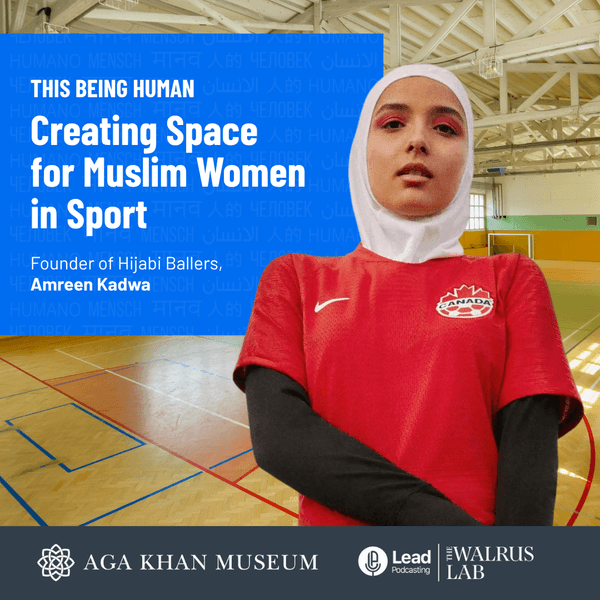
This Being Human - Amreen Kadwa
Hijabi Ballers was founded in 2017 by Amreen Kadwa, a young Muslim rugby player who felt isolated by the lack of hijab-wearing role models in sport. After connecting with other Muslim women athletes and realizing many shared similar experiences of exclusion, she created a space for community. A single Facebook post quickly connected her with dozens of women, leading to the first Hijabi Ballers Sports Festival, which drew over 200 participants. The success of that event showed the need for inclusive, dedicated spaces for Muslim women in sports.
Today, Hijabi Ballers is a non-profit organization that empowers Muslim girls and women through safe, inclusive sports programs that support both athletic and leadership development.
The Museum wishes to thank Nadir and Shabin Mohamed for their founding support of This Being Human.
Show Notes
Amreen Kadwa didn’t set out to build a nonprofit. She set out to find people like her: Muslim women who played sports and understood what it felt like to walk into a locker room and wonder if you belonged.
In this episode of This Being Human, host Mai Habib talks with Amreen about the winding road from rugby pitches in Toronto to founding Hijabi Ballers, an organization that’s grown from a single Facebook post into a multi-sport community reaching thousands of women across the GTA and beyond.
They dig into what changes when an athlete finally sees someone who looks like her on the field, how a bad injury became an unexpected turning point, and why partnerships with brands like Nike and the Toronto Raptors matter—not for the validation, but for what they make possible. Amreen also shares the simple piece of advice she gives every coach and ally who wants to do right by Muslim women athletes: stop guessing what they need, and ask.
Links & Resources
- This was just one example of Muslim art and culture that sparked curiosity and a great conversation. There is so much more to see at the Aga Khan Museum. Support the Museum’s vision to impact lives and contribute to more inclusive and peaceful societies. Go to agakhanmuseum.org to plan your visit or make a donation.
- Visit Hijabi Ballers online and follow them on Instagram.
- Explore the Hijabi Ballers Coaches Toolkit, designed to help coaches, parents, and allies support Muslim female athletes.
Visit the Aga Khan Museum’s website or follow us on Facebook and Instagram.
If you enjoyed this episode and want to learn more, go to agakhanmuseum.org/thisbeinghuman.
Mai Habib 0:20
Sport is one of the most powerful forces in our lives. It can get you out of your head, get you moving, make you happier, healthier. But sports also bring people together, whether it’s a few friends on a basketball court, 1000s in a stadium cheering, or a whole country gripped to the edge of their couch watching a playoff series. Today, we’re spotlighting Hijabi Ballers, a nonprofit founded by Amreen Kadwa, that’s creating space and community and opportunity for Muslim women in sports. I’m Mai Habib. Welcome to This Being Human, an Aga Khan Museum podcast about Muslim art, global cultures, and how we’re all connected. Amreen, thank you, and welcome to This Being Human.
Amreen Kadwa 1:02
Thank you so much for having me. It’s so exciting to be here.
Mai Habib 1:04
To start off, Amreen, I’ve heard you speak a lot about how sport is fundamental when it comes to creating community and that sense of belonging. What was missing for you in 2017 or through your athletic journey that prompted you to find to become a founder of Hijabi Ballers.
Amreen Kadwa 1:21
Yeah, I can start back and take us back to 2017 and so I was about 18 or so when I, or 1890 when I started Hijabi ballers, but a few years before that is when I started playing rugby, and I, I played rugby in Toronto, played for rugby for high school in Toronto, and it was very diverse. It was sort of my first time getting into sport, organized sport in a school setting, especially. And I always wanted to get into sport. I was always interested in it, but I just never had a chance until my grade 10, you know, or my high school had a rugby team in grade 10. So I joined my rugby team, and it was a really fun experience, and I got to come out of my shell and really step out of my comfort zone and build like this part of myself that I didn’t know was there, and it was in my teenage years, so it was very, yeah, it was just, it was just rugby was a part of me when I was growing, and my experience in high school was amazing, the coaches and the teammates were very diverse and very accepting, and I wore hijab in high school, but I really didn’t have understanding of what it meant outside of school, like I lived in my little bubble in high school, and that’s all I kind of knew, and no one really had a problem with me playing in hijab or wearing hijab, and I, you know, almost naively thought that that’s what the case was outside of high school, and obviously it wasn’t, but I really, really enjoyed rugby, like it was that space that introduced me to sport, and introduced me to the benefits of this is what sports can be like, and this is all the people you get to meet, and the cultures you get exposed to, and I really, my leadership skills grew, my teamwork, collaboration, communication, like all of that grew through rugby, and I’m so grateful to have had that, you know, chapter in my life. And then when I went on to play club rugby after high school, so in the summers it was again a really cool experience, it was a bigger community than what my high school was a little bit less diverse, but still diverse enough for me to feel included and welcomed. You know, there were moments in my, like, club rugby experience where, after games, you know, the team would want to go to a pub and the seniors on the team would drink, and it was maybe like moments like that that made me feel like, okay, I don’t know if I’m welcome here, I don’t know if I feel belonged here, but I feel like all in all, my team still did a really great job of making me feel included and making me feel welcome, like I was never pressured to, you know, or to drink or anything like that at all, but he was just being in those spaces that made me feel like, well, is you know, is this what sport is like outside of high school? You know, anyways, when I went on to university to train for my rugby team and try out for my rugby team at Guelph, I had a complete different experience. My rugby team at Guelph, at the training camp when I was trying out, was predominantly white. I was one of two colored people on the training camp squad, and I just felt very out of place, like I felt like I have a fair shot at making the team. I didn’t feel belonged, I didn’t feel like I could even advocate for my accommodation needs or prayer space or anything like that. Like, it just felt very clicky, and I, you know, deep down inside, I don’t know if I wanted to be a part of a team like that. I didn’t want rugby to become that, of course, I wanted to be a part of a rugby team, and I would have loved to, you know, grow in my athletic career and be part of my university team after having, you know, won my MVP in high school and in club rugby, like I really. Confident in my abilities, but I just didn’t fit in in the two weeks of trading camp, and it kind of, you know, gave me a snippet into what is sport like when you don’t feel belonged, and what does it feel like when you’re maybe not welcomed, and people around you don’t really understand you or resonate with you, and yeah, that wasn’t a very good feeling, but when I came back the next year to Toronto to play rugby in the summer, I ended up getting a really bad injury. I broke my tibia and fibula on my right leg, and it was, it was a bad break, and it, like, in the moment I was just heartbroken, because I thought, hey, I’ll never play rugby again, it’s never going to be the same again, like a sport injury is horrible.
Mai Habib 5:43
Anybody can relate to that, who’s had a sports injury, who’s just climbing in their kind of sports trajectory, right?
Amreen Kadwa 5:48
Yeah, it’s it’s not a good feeling, and you’re never, you know, even if you heal, you’re never the same, you’re never at 100% of what you used to be. So that thought was very devastating and heartbreaking, and then a year in the next year, when I was healing and recovering, I didn’t really have rugby, I didn’t have any sports space where I, you know, felt that sense of belonging and welcome, yeah, sense of belonging and safety, and I tried dragon boating, and it was, it was good, but it still didn’t compare to like the community that had built in rugby, like it was a completely new, different group of people, mostly white, and I just felt like, hey, this is a fun sport to try, but it’s, it’s not my community, it’s not where I belong. And then, yeah, I got into coaching rugby a little bit there, and I felt like even through coaching, I really did find my footing, and I found I found that coaching was something that really drew me back to sport, and in a way that I, in similar ways as when I was a player, and then when I coached, I, yeah, I learned a lot of leadership skills and program facilitation skills, and you know, how do I.. how can I be the one that creates this community for other Muslim girls? So I dabbled with the idea of Hijabi ballers in my head for a while. I really just wanted a space where Muslim women like me, who played sports, felt belonged and felt comfortable and confident. So I posted on Facebook asking people to connect me with Muslim female athletes that they knew, and overnight I was connected to about 70 people, so I started reaching out to them, and it was very apparent that, you know, a space like this didn’t exist, and it, yeah, I was missing, like people were people were like, oh, like reach out to this person and that person and make sure you connect with her, like she’s amazing, and it was just the energy was it was just so positive, and everyone was intrigued by this idea, and the fact that, hey, like this is definitely missing. We definitely need to, you know, find the space and create the space together. So, yeah, when I reached out to people, I, you know, I got connected to Shereen through that. She was one of my first mentors, Shereen Ahmed, and when I talked to her, she was, yeah, she was one of my.. she’s still one of my best mentors, but at that time, like, she kind of gave me a reality chip of, hey, this is what sports is like for Muslim women, and, like, you know, I’ll help you through it, like I’ll be here for you, sort of thing.
Mai Habib 8:22
I’m sure that validated your own experience too, right? Hearing it from so many other people,
Amreen Kadwa 8:26
yeah, yeah, of course. And even coaches, like my rugby coach, my club rugby coach, who was a Muslim, she was like, this is a great idea, like, you have, you know, you have my support, like, what do you need? It was just, yeah, it was great to have validation from mentors and coaches, people that I looked up to, but also from other athletes, from other people that I didn’t know, people who were just looking for that space, and you know, stumbled upon my post, sort of thing. I connected with about five, actually, I connected a lot of those 70 people that were mentioned in the comments, but I ended up meeting with about five of them, getting an idea of, like, what were their stories, like, what were their struggles, what were their struggles in sport, what were their accomplishments and achievements, and how did they get to where they are today, playing sport, and some of them were, you know, a little bit more skilled and talented and professional in their sports space, and some of them were beginners, but they’re still confident athletes, and that was the main thing. Was how can you be a confident athlete in whatever sport you’re playing, and whatever level of sport you’re playing as a Muslim woman, and as a hijab wearing Muslim woman, and a lot of these people that I spoke with were hijab wearing Muslim women, and confidence really was a big piece of it, the feeling of just feeling confident, feeling the feeling belongs, that would also contribute to you playing as an athlete, like if you’re feeling confident and you feel like you can fully be yourselves, then you’re a better athlete, you’re more skilled.
Mai Habib 9:52
Yeah, I think the big thing here is feeling included, right? Like you’re not just kind of like on the outside and they’re letting you in, you’re you really are part of the makeup of the team, the DNA of the team.
Amreen Kadwa 10:00
Yeah, and you know, a lot of the people I spoke with, they were maybe the only Muslim one on their team, but the difference was that their, their teammates were allies, their coaches were allies, they knew exactly what accommodations the person needed, they were, you know, you didn’t have to ask for anything without feeling like you were burdening the coach or burdening your teammates, there one story of a girl who shared with me, she heard a referee told her in one of the games that she couldn’t wear tights under her shorts because it didn’t match the team uniform, so the next game the entire team wore tights under their shorts so that they could be in uniform solidarity.
Mai Habib 10:36
Yeah,
Amreen Kadwa 10:37
yeah, exactly. So they’re they’re people who have that kind of connection and support from their teams, but then there were also people who didn’t, and Hijabi ballers was about creating a space where every Muslim woman felt like they had a had a place on the court, they had a place on the field, they didn’t feel like they were the only hijab or Muslim women, and then they had this burden of representing Islam and how Muslim women are like it started off as a blog post, but honestly, a lot of even early on, a lot of people just wanted something physical, they wanted a physical community space where we could just play sports together, and and then we had our very first sports festival, it was a multi-sport festival, I think we found it in like April or May, and then we had this big event in July, it was in summer, and we saw about over 200 people that came out to that event, and about like 70 or 80 Muslim women who registered to play in the multi-sport tournament. It just affirmed that the space is needed, and that all these people, people drove from Mississauga, from the like Durham, Pickering, like everywhere, to be in the space where they just wanted to play sports with other Muslim women, it wasn’t this like highly competitive tournament, it was just the space.
Mai Habib 11:47
So, for our listeners, it’s important to know all of these places that a marine is mentioning is in an area called the GTA, the Greater Toronto Area. So, all in the spaces, so you know people who aren’t as familiar with the geography, it’s important to know that it’s in Toronto, Canada, and you are still based in Toronto, Canada, and you know you have spoken about your experience, that is very Toronto’s like such a microcosm, right? There’s so much diversity, and like you said, you got a little bit outside of Toronto to Guelph, and you already kind of felt that difference.
Amreen Kadwa 12:18
Exactly. Yeah.
Mai Habib 12:19
What has have you had any kind of international pickup? We talk about the, you know, the sports, the handout, the toolkit for coaches to understand. You spoke of your own coaches or other women that you spoke to who said, you know, their coaches are super supportive. They were the only Muslim person. It’s not about being the only Muslim person, it’s how is everybody, how are you identified within that group, right? Like, it’s okay to be the only Muslim person. The point isn’t to be Muslim only, or you know, it’s just to feel included within that. So, a few questions packed in there, but you just, you have so much goodness in you. First, what are some of the obstacles that you feel like are preventing women, and also, have you had any kind of international engagement on your efforts, because really your experience is so Greater Toronto Area focused, which is very diverse.
Amreen Kadwa 13:13
Yeah, okay, so I’ll, I’ll touch on the international question first. I feel like in our last, like, or at least in our, in our first five to six years, we had a lot of traction through a couple of campaigns that we did with Nike, and it sort of blew up on Instagram or on Facebook, YouTube, whatever, and we had a lot of people who saw this video who are not from Toronto, and it was sort of our first reality check out, like hate comments as well, because people in Toronto, or people in our community, are nice, but it’s not the case outside of that. That was one thing, like we learned how to overcome and deal with that, but the positives that came out of it was that people all around the world, you know, pockets of Muslims from different cities, in like Germany, in the states, a lot of people in the states, the UAE, in the Middle East, like Pakistan, India, a lot of people would reach out to us and say, “Hey, like, this is really cool. How can I do something like this for my community here? So cool to see that small movement that we started here in Toronto could inspire people in all these other parts of the world, and what was, yeah, what was really beautiful about Hijabi Ballers is that wasn’t focused on one single sport, it was really just focused on any athletes, so you could be doing yoga and feel like you’re part of Hijabic Ballers, you could be skateboarding, whatever, running, like you could be doing so many things and still feel like you’re part of this big community, it didn’t have to be this one sport, and for a few years we had a lot of, you know, emails or Instagram DMs, and say, “Hey, like, how can I bring this movement here? And we created our coaches toolkit to sort of share our findings with other communities, and especially other metropolitan. In cities around the world, because what we have in Toronto, or at least the community that we have here, we have the resources for sport, not necessarily for our community, or not fully for our community, but in general, there are, you know, enough sport resources, but there’s also a lot of populations that are low income, there’s, you know, diversity in races, there’s diversity in religion, and there’s so many things that are unique to our city, but it’s also very similar and parallels across other metropolitan cities and other parts of Canada and other parts of the states and Europe, and really the goal was that if, or at least in my head, the concept was, well, if I can start something here, why can’t other people start, you know, similar movements across across the world? Really, all you need is a network of solid coaches and mentors that can kind of help you build something, and initiative, and confidence that this is something that other people do need, and you know, confidence that it will work out, and I’m so happy for all the Muslim women that you know have these communities and feel like they’re part of something when they play sports. So, yeah, that was answering one of the questions. And then the other part to that was we created the Hijabi Wallers app a few years ago, so we just discontinued it earlier on, earlier this year, but it was active for about three years, and that was also a digital space for Muslim women to connect, and we had a lot of international users there. We had people from over 20 different countries on the app, and it was almost.. it was like a social networking app for Muslim women who play sports. So, unfortunately, we have to discontinue it, because we just didn’t have the funds to like keep, keep it running, and also we noticed that the sport landscape has changed a lot in the last three years, especially for Muslim women, like I was saying, and we could do other things with the money that honestly serves the needs of our community today. So, yeah, that was those really cool, like one of our really cool accomplishments in terms of being present in the international sort of space,
Mai Habib 17:01
yeah. Absolutely, and you said that you are kind of pivoting with the funds that you have to offer more services. What are the different activities that Hijabi Ballers is offering today?
Amreen Kadwa 17:10
Okay, so we have about 10 programs going on right now, over, I guess, on an annual basis. We have ice skating and hockey that we offer in the winter, along with snowboarding, and then we have skateboarding in the fall and paddle boarding in the summer, so all the board sports are offered with another partner agency, and then we have running, fitness, rugby, soccer, basketball, like really all kinds of stuff. It just depends on tennis. Didn’t forget that, but we have all our programs are dependent on grant funding, so if we can get grant funds to fund our program, or even sponsors to cover our program costs, then we’ll run a program. And space is a huge issue as well, especially in Toronto. There’s just not enough sports spaces, and the sports spaces that do exist are quite inaccessible. You just have to jump through like 20 different hoops to secure a gym space, which is a little bit frustrating, especially for grassroots organizations and volunteer-led organizations. Thank God we’re not volunteer now, but we were pretty volunteer-led up until about two years ago. Yeah, our rookie skates program in the winter, we had an ice skating program, so we, you know, just rent out the arena. We had about 30 to 50 people like show up for the first couple of weeks, which was enough. Like, that was great. That was our capacity. We had enough volunteers to like handle it. We had enough skates to like give out to those people. So we also had skate lending, and then we had one of our videos blow up on Instagram and TikTok, and then
Mai Habib 18:42
social media does. Yes,
Amreen Kadwa 18:44
yeah. And then after the break in January, like our first week back, we had like 120 people, and we’re like, we have to turn people away, like I’m sorry, we have skates for everyone, we don’t have, we don’t have ice time for everyone, but a lot of these people, like they drove from, you know, 30, 40, 50 minutes to be there just for ice time with other Muslim girls, like they could go to an arena next to their house if they wanted ice time, but they don’t just want ice time, right? They want a community, so yeah, it was a one of our really popular programs, and very low commitment, like we didn’t really do anything, we just gave, we just made the space, right? Like, and that’s what it’s about. You just, you made that, make the space,
Mai Habib 19:23
you create the space, right?
Amreen Kadwa 19:25
Yeah, and if you’re a person that the community trusts, and you’re a leader that the community trusts, and they’ll show up.
Mai Habib 19:30
Have you seen any non-Muslim woman show up to your activities? I’m curious to see if there’s just like an appetite, yeah, if there’s an appetite from women to be in sort of safe spaces.
Amreen Kadwa 19:42
Oh, for sure, we have a lot of non-Muslims show up all the time, and honestly, we have a lot of non-Hijabis as well. So, a lot of people who are not visibly Muslim, and a lot of them, you know, might be Muslim, might not be Muslim. It doesn’t really matter, like you don’t have to identify as Muslims to take part in our programs, um. Um, and a lot of Muslim girls will show up with their friends who are non-Muslim, because that’s the space they feel comfortable, and they want to introduce their friends to the space. So, we have that all the time, even at our basketball tournament. So, we do an annual basketball tournament with Muslim moments of our basketball league, and at our tournament, we had – we have a, like, a policy that you can have. Actually, the first couple years we just had a, you know, anyone can sign up with a team, but we found that a lot of non-Muslim basketball players, especially, they’ve been playing basketball since they were young, they, their skills are at a different level, and then it was kind of making it a little bit intimidating for the Muslim girls that we’re trying to create space for, so we, you know, created a policy where you could, you couldn’t have up to two non-Muslim girls on your team for the sake of bringing your friends and, and you know, introducing them to the sport, or a lot of Muslim girls will play with their non-Muslim friends outside of Hijabi ballers, but they want to play with us with their friends as well, so we have a lot of girls, honestly, who show up with their friends, with their moms, with their sisters, siblings, whoever, that are not Muslim, that just want to be part of the space that we’ve created.
Mai Habib 21:10
What is in this toolkit that any, it is accessible? I’ve downloaded it, I thought it was fantastic. As a Muslim woman, I’m like, yeah, that’s true, and I really love that you also really emphasized the individualistic nature of religiosity. Not all Muslim women are visible, right? Like, they’re not all wearing the hijab, and even if they are wearing hijab, there’s different religiosity levels. And I just love that it’s very like, ask your athlete at the end of the day, she is the main source of information. So, tell us about that toolkit. What has the uptake been like, and what information are you sharing in there?
Amreen Kadwa 21:43
Yeah, honestly, the one main takeaway from that, like you said, is just ask your athlete, create the space for them to feel comfortable enough that they can tell you what they need. The coaches toolkit is meant for coaches, but also parents and also athletes, so it’s supposed to be, you know, things that can help you advocate for yourself as an athlete or a parent to help them advocate for their child or the coach, and it’s really just different parts of Islam that might intersect with sport. So, one of them is clothing, one of them is food and drink, physical touch, Ramadan, like there are different, yeah, there’s like, you said, there’s different levels of, you know, practicing Muslims, and not everyone practices the same way, but it’s important to hold space for people in the way that they do practice, so it’s just really meant to help coaches and advocates who want to be better allies and want to be better advocates for Muslim women athletes, help them do it the right way, so that the experiences that they’re creating for Muslim women athletes are positive, and that they’re not turning away from sport, and they’re coming back, you know, every week or every month to play.
Mai Habib 22:52
Yeah, absolutely, it’s filling, it’s filling the void in education, right?
Amreen Kadwa 22:56
Yeah, and the other, the other part of your question, we’ve shared it with schools, we’ve shared it with, you know, organizations in Toronto, in Canada, like even outside of Canada internationally, because it’s very universally applicable, like it’s not just something for, you know, Toronto or Canada, like it’s it’s just principles that intersect with with an athlete’s everyday life, so yeah, and we’ve been able to do that, and the response has been very positive. It’s very easy to read, it’s colorful, it’s super, yeah, it’s just easy to digest. It makes sense, yeah. And then we’re now rolling out another program called Hijabi Ballards in schools, which is sort of building on that idea of, like, what are the gaps in the school sports system, and how can we empower teachers and coaches in the school sports system to be better advocates for Muslim girls.
Mai Habib 23:50
We’re okay. Well, we’re waiting, and we’re excited for this, and you know, this movement, like you said, it’s so much bigger, right? There has been a general kind of uptick in women in sports, and especially Muslim women in sports, Muslim women competing at, like, the Olympic level, too, right? Like, this is really sort of a breakthrough moment for Muslim women. So much so that Nike, kind of around the same time that you were creating Hijabi ballers, um, they also started this, their pro-hijab line, right? Like, they identified, much like you this missing space and this big audience and client base that wasn’t that they were being serviced by maybe like smaller, more niche companies and organizations, but not in the pro line, not in like the major companies and major brands, so that also translated to around the same time of the Toronto Raptors winning the NBA championship, I think it was like the 2019 timeframe. They too were inspired by Hijabi ballers and created like an NBA branded line for the Toronto Raptors. What has all that meant like? What is that culmination to you as a feeling as progress? What does that feel like?
Amreen Kadwa 24:59
It definitely feels. Also, validating to know that brands are, you know, finally seeing us and recognizing us. We want to keep doing what we’re doing without needing the validation of big brands and corporate corporations, but at the same time, it’s important to have people who have power behind you and having your back. So, it’s Nike’s been one of our really good supporters and partners as well, like they fund a lot of our programs, which is really amazing to see that it didn’t – the partnership didn’t just start and end up the hijab, like it’s been growing for the last seven eight years. We actually have a modest active wear exhibit as part of our annual basketball tournament, so for the last two years we spotlighted, I think 10 or 11 brands like overall modest active wear brands that have modest active wear options, and there are there’s so much variety, and it’s so nice to see. It’s just wonderful to see the diversity in options our community is creating for ourselves, and as great as it is to have Nike and Adidas and Gymshark, and all these brands have modest active rail lines. It’s also just as empowering to see our own community make spaces for ourselves, and you know, create products that we would need and didn’t have previously. So, I just.. I’d love to see it. I love to see the options, and every person has their own preference, and even with sport, like a contact sport, might require different hijab and different attires than a non-contact sport, so it’s just there’s so many varieties, and it’s great, even swimming, like there’s people who want to swim recreationally, but people who want to swim competitively, and those are two completely different attires with swimsuits, so it’s great to see the options. It’s great to see that we have options. Not having the clothing to play sport can’t be an excuse, like it can be an excuse for anyone. It’s like there are so many options that it shouldn’t be a barrier to entry for sport for the Muslim girls.
Mai Habib 26:59
You’ve been in the space of Marine for almost a decade now, what have you seen change in that time, and what opportunities do we still have to make it better?
Amreen Kadwa 27:08
Yeah, I think the cultural shift has been huge, though. There’s the generation now is a lot more accepting of sports, sees a value in sport, especially within the Muslim community. Like when I was playing sport, people didn’t really care about sports, like, like Muslim immigrant parents didn’t value sports, they didn’t see any value in sports compared to, like, academics or education. Yeah,
Mai Habib 27:31
right, exactly. Yeah,
Amreen Kadwa 27:32
like, why are you spending two hours playing rugby when that those two hours you could be used, whatever, study and to prepare for your exam? Like, it’s just the benefits of sport just wasn’t seen in that same perspective, and now I think the mindset has changed a lot, and especially, like, you know, the generations have changed too, like, our, we’re becoming parents, and we’ve gone through the sport system, and we know what what it means to have access to sport, and we’re providing those opportunities for our children, so it’s just inspiring to see the growth that we have made, especially in our culture.
Mai Habib 28:06
That’s fantastic. Just as a ending, Mark, what’s your message to those who are thinking about including or trying to be inclusive of Muslim athletes, Muslim women athletes, like people who are listening who just aren’t as familiar with the space as you are, what’s sort of your, your main message to folks, because I think people are, you mentioned this earlier, but just very sensitive of saying the wrong thing, doing the same wrong thing, even if their intention is good.
Amreen Kadwa 28:33
Yeah, I don’t know if your intention is good, I wouldn’t worry about saying the wrong thing, like I, especially as a coach, if you have a good relationship with your athlete, the most important, like, the best thing you can be is honest and open, and that’s creating a space for your athlete to be honest and open. So, as long as you’re a good person with a good heart and have that good relationship with your athlete, I think that’s the main thing, like, don’t go into it with preconceived biases and notions of what this, what she should do, or what she shouldn’t do. Like, if an athlete is fasting in Ramadan, don’t tell her don’t fast because it’s bad for you or you’re gonna dehydrate. Support her, ask her what she needs, like it’s that difference, right? Like, don’t go into it thinking you know what’s best for the athlete, but make space for for her to share with you what what she needs.
Mai Habib 29:23
I love that. Okay, great message for everybody around. Amarin, thank you so much for joining us on this Being Human and sharing your story with Hijabi ballers.
Amreen Kadwa 29:32
Thank you so much. It was lovely meeting you and speaking with you, and I hope this episode resonates with a lot of listeners.
Mai Habib 29:39
This Being Human is brought to you by the Aga Khan Museum, a place where centuries of art inspire new conversations every day. This podcast is produced by Jules Owenby and edited by Zia Khalid. Amanda Capito is our executive producer. I’m Mai Habib. If you enjoyed this episode of This Being Human, be sure to hit that follow button and catch the. Next episode available on YouTube, and wherever you get your podcasts.